
How to Cure Bad Breath (Halitosis) Permanently: A Mumbai Dentist's Honest Guide
There's a moment most adults experience at least once: you're talking to a colleague, a relative at a wedding, or a stranger in the local — and they subtly lean back. They turn their face slightly. They cover their mouth when they reply. You feel a small flicker of dread: is it me?
If you've ever wondered, the honest answer is — probably yes, at some point. Bad breath (medical name: halitosis) is one of the most common dental concerns we see at our Jogeshwari clinic. It's also the one patients are least likely to ask about in person. They quietly buy mouthwash, chew elaichi after meals, switch toothpastes — and silently hope it's enough.
It usually isn't. Mouthwash, mints and chewing gum mask bad breath for 30 minutes. They don't cure it. To genuinely fix bad breath permanently, you have to find the actual cause — and 95% of the time, the cause is in your mouth and easily treatable.
This guide walks you through the 7 real causes of bad breath, a private DIY test you can do at home, the genuine permanent cures, and the small number of cases where bad breath is signalling a bigger health issue.
Why Mouthwash and Mints Don't Work (And What Actually Does)
Walk into any chemist in Mumbai and you'll see shelves of mouthwashes, "fresh breath" lozenges and minty chewing gums. Patients use them religiously and wonder why their breath comes back within an hour.
The reason is simple: bad breath is caused by bacteria producing sulphur gases inside your mouth. Mouthwash with alcohol kills some bacteria temporarily — but within 30 minutes the bacteria recover, the gas production resumes, and the smell returns. Mints and chewing gum just add a stronger smell on top of the existing one. Neither approach addresses where the bacteria are hiding — and that's the only permanent fix.
The bacteria almost always live in one of seven places. Find which one is yours, and the cure becomes obvious.
The 7 Real Causes of Bad Breath
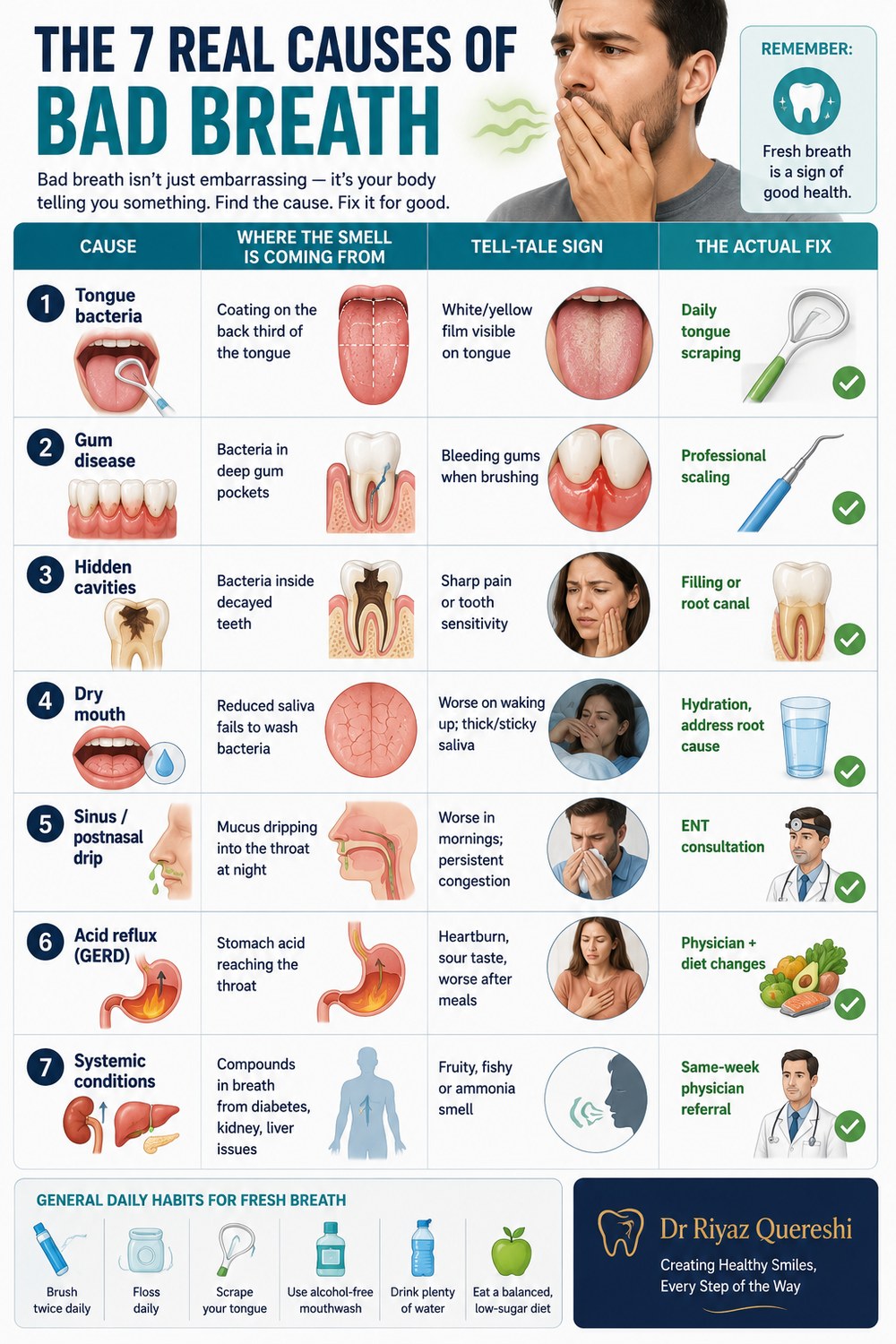
| Cause | Where the smell is coming from | Tell-tale sign | The actual fix |
|---|---|---|---|
| Tongue bacteria | Coating on the back third of the tongue | White/yellow film visible on tongue | Daily tongue scraping |
| Gum disease | Bacteria in deep gum pockets | Bleeding gums when brushing | Professional scaling |
| Hidden cavities | Bacteria inside decayed teeth | Sharp pain or tooth sensitivity | Filling or root canal |
| Dry mouth | Reduced saliva fails to wash bacteria | Worse on waking up; thick/sticky saliva | Hydration, address root cause |
| Sinus / postnasal drip | Mucus dripping into the throat at night | Worse in mornings; persistent congestion | ENT consultation |
| Acid reflux (GERD) | Stomach acid reaching the throat | Heartburn, sour taste, worse after meals | Physician + diet changes |
| Systemic conditions | Compounds in breath from diabetes, kidney, liver issues | Fruity, fishy or ammonia smell | Same-week physician referral |
The first three causes (tongue, gums, cavities) explain about 85–90% of all bad breath cases. They're all dental issues, all affordable to fix, all permanent once treated.
Cause #1: Tongue Bacteria (The #1 Culprit Most People Miss)
Stick your tongue out in front of a mirror. Look at the back third — the part closer to your throat. If you see a white or yellow coating, that's not food. It's a thick layer of bacteria, dead cells and food particles trapped in the rough surface of the tongue.
The back of the tongue is the single most common source of bad breath — accounting for an estimated 80% of all cases. The reason: the surface is full of tiny crevices, oxygen levels are low (which favours the smelly anaerobic bacteria), and most people brush only their teeth, never their tongue.
The fix is daily tongue cleaning. Specifically:
- Use a tongue scraper (₹50–₹300 at any chemist) — far more effective than a toothbrush
- Scrape from the back to the front, applying gentle pressure, 4–6 times every morning
- Rinse the scraper between strokes
- Do this before brushing, on an empty stomach
- Within 1–2 weeks, the white coating reduces visibly and breath improves dramatically
This single habit fixes more bad-breath cases than any mouthwash on the market.
Cause #2: Gum Disease (Bleeding Gums = Bad Breath)
If your gums bleed when you brush or floss, you have at minimum gingivitis, and possibly periodontitis. Both produce a distinctive bad smell from the bacteria living in inflamed gum tissue and (for periodontitis) the deep pockets that form between teeth and gums.
You cannot brush or rinse your way out of gum disease. The hardened tartar (calculus) that's harbouring the bacteria can only be removed professionally with ultrasonic scaling.
After a single scaling visit (₹1,000–₹2,500 in Mumbai), most patients notice their breath improve within a week. For more details on the gum-disease side specifically, see our guide: Why do my gums bleed when I brush?.
Cause #3: Hidden Cavities and Decayed Roots
A cavity that's reached the inner part of a tooth becomes a small pocket of decaying organic matter — a perfect home for sulphur-producing bacteria. The smell from a single deep cavity can be surprisingly strong.
Sometimes patients don't even know the cavity exists — it's between two teeth, under a crown, or inside a tooth that doesn't yet hurt.
The fix is finding and treating the cavity. A clinic exam with X-rays takes 15 minutes and reveals every cavity in your mouth. A small filling costs ₹800–₹2,500; a root canal (if the decay has reached the nerve) is ₹4,000–₹8,000. The bad breath usually disappears within days of treatment.
Cause #4: Dry Mouth (Xerostomia)
Saliva is your mouth's natural cleansing system — it constantly washes away bacteria and food particles. When saliva flow drops, bacteria multiply rapidly. This is why breath is often worst first thing in the morning ("morning breath") — saliva flow naturally decreases at night.
Common causes of chronic dry mouth:
- Mouth breathing at night (often due to nasal congestion or sleep apnoea)
- Medications — antihistamines, antidepressants, blood pressure drugs, diuretics
- Dehydration — Mumbai's heat means many adults are mildly dehydrated all day
- Diabetes — uncontrolled blood sugar reduces saliva
- Mouth breathing as a chronic habit (often dating back to childhood)
- Salivary gland conditions (rarer)
The fix depends on the cause:
- Drink 2–3 litres of water daily, sip through the day rather than gulping at meals
- Chew sugar-free gum with xylitol — stimulates saliva flow
- If it's medication-related, ask your physician about alternatives
- For nighttime dry mouth, see an ENT to address nasal blockage
- Avoid alcohol-based mouthwashes — they make dry mouth worse (counter-intuitively)
Cause #5: Sinus Issues and Postnasal Drip
Mucus from the sinuses dripping down the back of the throat overnight feeds bacteria and creates a distinctive morning smell. Common causes: chronic sinusitis, deviated septum, allergies (Mumbai's monsoon humidity makes this worse), polyps.
The fix: an ENT consultation. No amount of dental treatment will cure sinus-related bad breath — the source isn't in your teeth or gums. Treatment of the underlying sinus issue (saline irrigation, decongestants, allergy management, or surgery for polyps) usually resolves the breath issue completely.
Cause #6: Acid Reflux (GERD)
If you experience heartburn, a sour taste in your mouth, or worse breath after meals, you may have gastroesophageal reflux disease. Stomach acid travelling up to the throat carries with it food odours and creates an environment that supports bacterial growth in the throat.
Tell-tale signs of GERD-related bad breath:
- Worse after large meals or when lying down
- Sour or bitter taste in the mouth
- Burning sensation in the chest after eating
- Frequent throat clearing or chronic cough
The fix is a physician consultation. Treatment includes diet changes (smaller meals, avoid spicy/oily food before bed, no eating 3 hours before sleep), elevation of the head while sleeping, and medications like proton pump inhibitors when needed.
Cause #7: Systemic Conditions (When Breath Signals Bigger Issues)
In a small number of cases, bad breath is the first warning of a serious systemic condition. The smell often has a distinctive character that's different from typical bad breath:
- Fruity / acetone smell — uncontrolled diabetes (diabetic ketoacidosis is a medical emergency)
- Ammonia / urine-like smell — kidney disease
- Musty / fishy smell — liver disease
- Sweet / faecal smell — bowel obstruction (rare)
If your bad breath has any of these distinct characters and isn't improving with dental treatment, see your physician without delay. A simple blood test rules out the common causes.
The Tongue Test: A Private DIY Diagnostic
Before you visit a dentist, you can run a quick at-home test in private to figure out which cause is most likely yours:
- Wash your hands. Lick the back of your wrist with the back of your tongue (not the front). Wait 30 seconds for the saliva to dry. Smell your wrist.
- If your wrist smells: the cause is likely tongue or gum bacteria — start with daily tongue scraping and book a dental scaling.
- If your wrist doesn't smell but you've been told you have bad breath: the cause may be further back — sinus, throat or stomach. Start with an ENT or physician consultation.
- The cotton-floss test: floss between your back teeth, then smell the floss. If it smells strongly, the cause is gum disease or a hidden cavity in that area — book a dental check.
This is the simplest way to narrow down the cause before spending money on the wrong solution.
Indian Diet: What Genuinely Helps and What's Just Tradition
Mumbai's food culture has multiple traditional "after-meal" remedies for breath. Some genuinely work, some don't:
What genuinely helps:
- Cloves (laung) — naturally antibacterial; chewing one or two reduces oral bacteria mildly
- Cinnamon (dalchini) — antibacterial properties; small but real benefit
- Crunchy raw vegetables (carrot, cucumber, apple) — physically scrape food off teeth; stimulate saliva
- Plain water sip after every meal — washes away food particles before bacteria can act on them
- Drinking plain water through the day — addresses underlying dry mouth (the most underrated breath fix)
What's mostly cultural / placebo:
- Cardamom (elaichi) — covers up the smell for 20–30 minutes; doesn't address the cause
- Fennel (saunf) — same as cardamom; mostly masking
- Mouth fresheners (mukhwas) — high sugar content, often makes the problem worse long-term
- Mint chewing gum — fine occasionally; not a substitute for cleaning
What makes bad breath worse:
- Paan, gutkha, tobacco — major source of chronic bad breath, in addition to staining and gum disease
- Onion and garlic in heavy quantities — temporary smell that lasts hours regardless of brushing
- Heavy non-vegetarian meals late at night — combined with reduced overnight saliva flow, causes morning breath
- Skipping breakfast — empty stomach = reduced saliva = worse breath through the morning
The Permanent-Cure Protocol
If you commit to this protocol, 95% of bad-breath cases resolve within 4–6 weeks:
- Tongue scrape every morning before brushing — back to front, 4–6 times
- Brush twice daily, soft brush, 2 full minutes, including the gumline
- Floss once daily (preferably before bed) — removes the hidden plaque between teeth where bacteria hide
- Drink 2–3 litres of water through the day, every day
- Book a professional scaling at a dentist — every 6 months if you smoke, chew paan or have any history of gum disease; every 12 months otherwise
- Check for cavities at the same dental visit — even small ones can cause bad breath
- See an ENT if your breath issue is worse in the mornings or you have any sinus symptoms
- See a physician if you suspect reflux or have any of the systemic warning smells
That's it. Most patients see real improvement within 2 weeks of starting this protocol consistently.
Frequently Asked Questions
Is bad breath always from the mouth?
About 90% of the time, yes. The remaining 10% comes from sinus issues, the throat, the stomach, or systemic conditions. Run the tongue test (above) to figure out which category yours falls in. If your wrist saliva smells, the source is in your mouth and a dental visit is the right starting point.
Can mouthwash actually cure bad breath?
No — mouthwash kills surface bacteria for 30 minutes and then they recover. Alcohol-based mouthwashes can actually worsen bad breath long-term by drying out the mouth. Antibacterial mouthwashes (chlorhexidine) help temporarily after a scaling, but they're not a permanent solution. The cure is removing the source of the bacteria — not chemically killing them every few hours.
Why does my breath smell bad in the morning even though I brush at night?
"Morning breath" is normal even for healthy mouths — saliva flow drops dramatically during sleep, allowing bacteria to multiply overnight. If your morning breath is severe and lingers past brushing, the cause is usually mouth breathing during sleep (often due to nasal congestion or mild sleep apnoea) plus tongue bacteria. Tongue scraping every morning is the single most effective fix.
Is bad breath a sign of bad oral hygiene?
Often, but not always. Many patients with excellent brushing and flossing habits still have bad breath because they've never cleaned their tongue, or because they have a hidden cavity, or because of a non-dental cause (sinus, GERD). Don't assume it's a hygiene failure on your part — get a proper diagnosis.
Can I tell if I have bad breath myself?
Self-detection is unreliable because we adapt to our own smell. The wrist-lick test is the simplest way to check yourself. For a more honest answer, ask one trusted person ("be brutally honest — does my breath smell?"). Or come in for a dental check — modern dental clinics have a small device called a halimeter that measures the actual sulphur compounds in your breath.
Do you treat halitosis at your Jogeshwari clinic?
Yes. We diagnose the cause first (tongue exam, gum check, X-rays for hidden cavities, halimeter reading if needed), then treat the underlying issue. Most cases resolve with a scaling + tongue scraping protocol in 2–3 weeks. We also work with ENT and physician colleagues for the small number of cases where the cause is non-dental. We treat patients from across Andheri, Bandra, Goregaon, Oshiwara, Vile Parle and the western Mumbai suburbs. See our contact page for directions.
You Don't Have to Live With It
Bad breath is a fixable problem. It's not a personality flaw, it's not "just how your mouth is", and it's almost never genetic. In 95% of cases, a proper diagnosis followed by a focused 4–6 week treatment protocol resolves it permanently.
The hardest part is the first step — admitting it might be a problem and booking the consultation. We've had this conversation hundreds of times in our Jogeshwari clinic. We'll be straightforward, professional and discreet. No judgement.
Ready to fix bad breath at the source — for good?
- Call or WhatsApp: +91 98679 33139
- Book online: trusmiledentist.in/book/ — pick your slot in under a minute
- Visit: Shop No 11, Ruby Tower, Off S V Road, Sahakar Road, Jogeshwari West, Mumbai 400102
- Hours: Mon–Sat 10 AM – 1:30 PM and 5 PM – 9 PM · Sunday by appointment
- Meet our team: Tru Smile's specialists
19+ years in practice · 10,000+ happy patients · advanced sterilisation protocols · discreet, judgement-free consultations.