Why Do My Teeth Hurt with Cold Water or Hot Chai? A Mumbai Dentist's Guide to Tooth Sensitivity
It's a normal Mumbai afternoon. You take a sip of cold lassi at lunch — zing! — a sharp pain shoots through one tooth. Or you're enjoying your evening cutting chai at the tapri — zing! — same sharp pain, this time from heat. You wince, swallow, carry on with your day. By bedtime you've half-forgotten about it.
Until it happens again the next day.
If this sounds familiar, you're not alone. Tooth sensitivity is one of the most common dental complaints we see in our Jogeshwari clinic — and one of the most misunderstood. Most patients try a few different toothpastes, decide it's "just how my teeth are", and live with it for years.
Here's the truth: tooth sensitivity is a symptom, not a condition. Something is making the inside of your tooth more exposed than it should be — and depending on the cause, the fix ranges from a different toothbrush to a root canal. This guide explains the six common causes in plain language, what genuinely works at home, when professional treatment is needed, and the specific warning signs that mean don't ignore this.
What's Actually Happening Inside Your Tooth
Picture a tooth as having three layers:
- Enamel — the hard white outer shell. Not very sensitive. Strong and protective.
- Dentin — the slightly softer yellow layer underneath. Filled with thousands of microscopic tubes (called dentin tubules) that connect directly to the nerve in the centre of the tooth.
- Pulp — the nerve and blood vessels at the core.
Healthy teeth have enamel covering the dentin completely, so cold and hot drinks never reach the nerve. Sensitivity happens when the dentin gets exposed — either because the enamel above it has worn away, or because the gum that was protecting it has receded. Cold or hot then travels straight down those tubules to the nerve, which fires a sharp pain signal.
The cause matters because the fix is different for each. Let's break them down.
The 6 Main Causes of Tooth Sensitivity
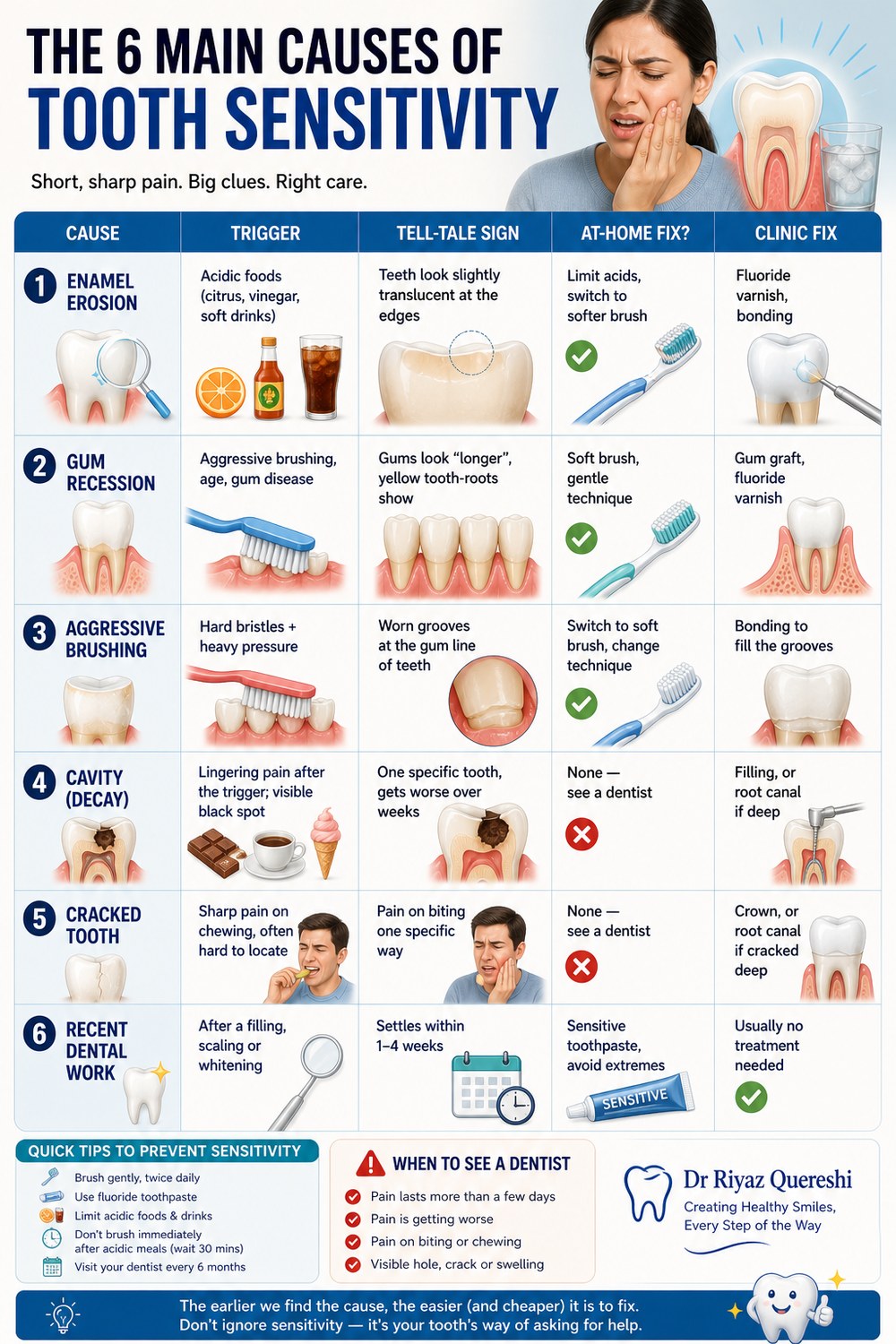
| Cause | Trigger | Tell-tale sign | At-home fix? | Clinic fix |
|---|---|---|---|---|
| Enamel erosion | Acidic foods (citrus, vinegar, soft drinks) | Teeth look slightly translucent at the edges | Limit acids, switch to softer brush | Fluoride varnish, bonding |
| Gum recession | Aggressive brushing, age, gum disease | Gums look "longer", yellow tooth-roots show | Soft brush, gentle technique | Gum graft, fluoride varnish |
| Aggressive brushing | Hard bristles + heavy pressure | Worn grooves at the gum line of teeth | Switch to soft brush, change technique | Bonding to fill the grooves |
| Cavity (decay) | Lingering pain after the trigger; visible black spot | One specific tooth, gets worse over weeks | None — see a dentist | Filling, or root canal if deep |
| Cracked tooth | Sharp pain on chewing, often hard to locate | Pain on biting one specific way | None — see a dentist | Crown, or root canal if cracked deep |
| Recent dental work | After a filling, scaling or whitening | Settles within 1–4 weeks | Sensitive toothpaste, avoid extremes | Usually no treatment needed |
Cause #1: Enamel Erosion (The Indian Diet's Hidden Damage)
Strong tea, lemon water in the morning, kokum sherbet, vinegar in chaat, soft drinks, frequent fresh-lime soda — Indian eating habits include a lot of mild acids. Each acidic exposure briefly softens the enamel for ~30 minutes. Most of the time saliva remineralises it. But repeated acid attacks (especially throughout the day rather than at meals) gradually thin the enamel.
Once enamel thins past a critical point, dentin becomes exposed and sensitivity starts.
What helps:
- Don't sip acidic drinks slowly — drink them in one go, ideally with a meal
- Rinse with plain water immediately after anything acidic
- Wait 30 minutes before brushing after acid exposure (brushing softened enamel scrubs it away)
- Use a fluoride toothpaste — it remineralises enamel
- A clinic-applied fluoride varnish can re-harden mildly eroded enamel
Cause #2: Gum Recession
When gums pull back from the tooth, the yellow root surface (which has no enamel) gets exposed. This area is very sensitive to temperature changes. Causes of recession include:
- Aggressive brushing with a hard-bristled toothbrush
- Long-standing gum disease (gingivitis → periodontitis)
- Natural ageing
- Genetics (some patients have naturally thin gum tissue)
- Tongue or lip piercings rubbing the gum
What helps:
- Switch to a soft-bristled toothbrush immediately — this alone solves a surprising number of cases
- Use small circular motions, not horizontal scrubbing
- Get any gum disease treated — recession from gingivitis can stabilise once the infection is gone
- For severe recession exposing root surfaces, a gum graft restores coverage (₹15,000–₹30,000 per area)
Cause #3: Aggressive Brushing (Most Common Cause)
This is the cause we see most often in our clinic, and patients are always surprised by it. They've been told their whole life to "brush properly" and assumed that meant harder. They use a medium or hard toothbrush, scrub side-to-side with strong pressure, and over the years carve visible grooves into the teeth right at the gum line — a condition called abrasion.
Those grooves expose dentin. The result is sharp sensitivity along the entire row of teeth, especially on the right side (most people brush harder on their dominant side).
What helps:
- Soft-bristled brush. Always. Medium and hard brushes have no place in modern dentistry.
- Hold the brush like a pencil, not a fist. Light pressure.
- Use small circular motions, not horizontal scrubbing.
- Consider an electric toothbrush — they have built-in pressure sensors that beep if you push too hard.
- Existing grooves can be filled in at the clinic with tooth-coloured bonding (₹1,500–₹3,000 per tooth), which both stops the sensitivity and protects the area.
Cause #4: A Cavity
A small cavity that hasn't reached the nerve yet often shows up as temperature sensitivity in one specific tooth. Cold makes it zing; eating sweets makes it ache; pressing on it might be uncomfortable.
Tell-tale signs that sensitivity is from a cavity (not generic enamel wear):
- Only one tooth (or a small group) is affected, not your whole mouth
- The pain lingers for 30+ seconds after the trigger goes away (generic sensitivity stops within seconds)
- It's getting worse week-on-week
- You can sometimes see a small dark spot or a hole
A cavity will not heal at home. Sensitive toothpaste won't fix it; it just masks the early warning. Catching it early means a small filling (₹800–₹2,500). Letting it progress means a root canal (₹4,000–₹8,000) plus crown (₹4,000–₹15,000+).
Cause #5: A Cracked Tooth
This one's tricky — small cracks often don't show up on X-rays and can be hard to spot. Symptoms:
- Sharp pain when biting down (not when temperature changes alone)
- Pain on releasing the bite (sometimes worse than the bite itself)
- Often comes and goes — bothers you for a week, settles for a month, returns
- Frequently a tooth that already has a large filling
Cracked teeth need a dentist's exam. We use specific tests (a "tooth slooth" bite test, transillumination, dye marking) to locate them. Treatment is usually a crown to hold the cracked tooth together, or a root canal first if the crack reaches the nerve. Untreated cracks tend to grow and eventually split the tooth in two — at which point it has to be extracted.
Cause #6: After a Recent Dental Procedure
Brand-new sensitivity after a filling, scaling or whitening session is usually temporary and not a problem. Common causes:
- After a filling: 1–4 weeks of mild cold sensitivity is normal as the nerve settles down
- After a scaling: gum tissue tightens up and exposes a slightly more of the root for a few days. Settles within a week.
- After whitening: hydrogen peroxide briefly opens the dentin tubules. Sensitive toothpaste for 2–4 weeks usually fixes it.
If sensitivity from any of these worsens over time or persists past a month, come back for a check.
What Works at Home: Honest Take on Desensitising Toothpastes
Walk into any Mumbai chemist and you'll see a wall of "sensitive" toothpastes. Most contain one of two active ingredients:
- Potassium nitrate — calms the nerve fibres inside the dentin tubules. Slow-acting (4–6 weeks of consistent use) but very effective for generic sensitivity.
- Stannous fluoride or arginine — physically block the dentin tubules from the surface, stopping the temperature signal from travelling. Faster acting (some relief within 2 weeks).
Brands that work (any reasonably well-stocked Indian pharmacy):
- Sensodyne (multiple variants — the Rapid Action one with stannous fluoride works fastest)
- Colgate Sensitive Pro-Relief
- Vantej (Indian brand, more affordable, contains potassium nitrate)
How to use them properly (most people get this wrong):
- Brush with the sensitive toothpaste twice daily, soft brush, gentle pressure
- After brushing, don't rinse with water immediately — spit out the foam, but leave the residue on the teeth so the active ingredient continues working
- Or: rub a pea-sized amount directly onto sensitive spots with your fingertip and leave it there for 1–2 minutes before bed
- Be patient — most patients see real improvement only after 2–4 weeks of consistent use
What doesn't work (despite the marketing):
- Salt water rinses for sensitivity (good for gum inflammation, not sensitivity)
- Charcoal toothpaste (often makes it worse — abrasive)
- Oil pulling for sensitivity (no clinical evidence)
- "Whitening + sensitivity" toothpastes (the whitening abrasives counteract the desensitising agent)
If you've used a desensitising toothpaste correctly for 4 weeks and the pain hasn't reduced significantly — the cause isn't generic enamel wear. Time to see the dentist.
When Sensitivity Is Actually a Warning Sign
Most sensitivity is annoying but not dangerous. These specific patterns mean don't wait for a routine appointment:
- Pain that lingers for more than 30–60 seconds after the cold/hot trigger has gone — possible irreversible nerve inflammation requiring a root canal
- Pain on biting down in one specific tooth — possible cracked tooth
- Spontaneous throbbing at random moments, especially at night — possible abscess
- Pain that wakes you up from sleep — almost always serious; same-day appointment
- Visible swelling on the gum near a sensitive tooth — abscess
- A dark spot or hole you can see in the mirror
- Fever or swollen face — dental emergency
For any of these, call us same-day on +91 98679 33139 or book online.
Professional Treatments at the Clinic
If home care isn't enough — or if a specific cause (cavity, cracked tooth, severe recession) is the issue — we have several effective options:
- Fluoride varnish application — clinic-strength fluoride that re-mineralises enamel and seals the dentin tubules. Quick, painless, no anaesthesia. Lasts 3–6 months. ₹500–₹1,500
- Bonding — tooth-coloured composite that fills in worn grooves at the gum line. Permanent fix for brushing-abrasion damage. ₹1,500–₹3,000 per tooth.
- Sealants on exposed root surfaces — a thin protective coat applied to recession areas. ₹500–₹1,500 per tooth.
- Treatment of the underlying cause — filling for a cavity, crown for a cracked tooth, gum graft for severe recession, root canal if the nerve is involved.
We'll diagnose the actual cause first — never just paint a fluoride varnish over an underlying cavity hoping it'll mask the problem.
Frequently Asked Questions
Why are my teeth suddenly sensitive when they were fine before?
Sudden onset usually points to a specific event rather than slow enamel wear. Common triggers: a recent filling or scaling (settles in 1–4 weeks), a cracked tooth, a small cavity that just reached the dentin layer, or a new aggressive brushing habit. If it doesn't settle in a few weeks, get it checked.
Can sensitivity go away on its own?
Yes for some causes (post-procedure sensitivity, mild enamel erosion that you address with diet changes), but no for others (cavities, cracks, severe recession). The honest test: if generic sensitive toothpaste used correctly for 4 weeks doesn't help, the cause isn't fixable at home.
Is sensitive toothpaste safe for daily long-term use?
Yes — sensitive toothpastes are designed for indefinite daily use. They contain the same fluoride as regular toothpaste plus a desensitising agent. Switching back to regular toothpaste once your sensitivity settles is fine, but many patients with chronic sensitivity stay on Sensodyne or similar permanently with no issues.
Can teeth whitening cause permanent sensitivity?
No — whitening sensitivity is almost always temporary. Modern in-clinic whitening uses a custom gum barrier and controlled gel concentration; sensitivity typically lasts 2–4 weeks and resolves completely. If you have pre-existing sensitivity, tell your dentist before whitening so they can apply a desensitising treatment alongside.
What's the best toothbrush for sensitive teeth?
A soft-bristled brush — manual or electric. Avoid medium and hard brushes entirely. Electric brushes (especially Oral-B, Philips Sonicare) often help because they remove plaque well without needing pressure, and most have built-in pressure sensors that warn you if you push too hard. Replace your brush every 3 months.
Do you treat sensitive teeth at your Jogeshwari clinic?
Yes — sensitivity is one of the most common reasons patients visit us. We start with a proper diagnosis (because the cause matters), then choose the right treatment from fluoride varnish, bonding, root canal, or whatever the underlying cause requires. We treat patients from across Andheri, Bandra, Goregaon, Oshiwara, Vile Parle and the western Mumbai suburbs. See our contact page for directions.
Stop Living With the Zing
Tooth sensitivity isn't something you should "just get used to". Every single one of the six causes has a specific, effective treatment — most of them simple, most of them affordable, all of them better than dreading every cold drink and hot chai for the rest of your life.
If sensitive toothpaste used correctly for a month hasn't helped — that's the sign. Come in, find the actual cause, get the right fix.
Ready to figure out what's causing your sensitivity?
- Call or WhatsApp: +91 98679 33139
- Book a consultation online: trusmiledentist.in/book/ — pick your slot in under a minute
- Visit: Shop No 11, Ruby Tower, Off S V Road, Sahakar Road, Jogeshwari West, Mumbai 400102
- Hours: Mon–Sat 10 AM – 1:30 PM and 5 PM – 9 PM · Sunday by appointment
- Meet our team: Tru Smile's specialists
19+ years in practice · 10,000+ happy patients · advanced sterilisation protocols.