
Why Do My Gums Bleed When I Brush? A Mumbai Dentist's Guide to Causes, Treatment & Prevention
It's a typical busy Mumbai morning. You're rushing to catch the 8:15 local, brushing your teeth quickly — and when you spit into the sink, there's a streak of red. What do you do? If you're like most people, you rinse, ignore it, and rush out the door.
Many patients walk into our Jogeshwari clinic believing a little bleeding while brushing is "normal" — maybe they brushed too hard, or the bristles were too stiff. Let's clear up the most dangerous dental myth in India right now: healthy gums do not bleed.
If your hands bled every time you washed them, you'd see a doctor immediately. Your gums deserve exactly the same urgency. Bleeding is your body's earliest, clearest warning of an active gum infection — and ignoring it doesn't make it go away, it makes it permanent.
This guide explains exactly what's happening in your mouth, when bleeding becomes an emergency, and the simple, painless treatment that stops it for good.
The Silent Progression: From a Sticky Snack to Tooth Loss
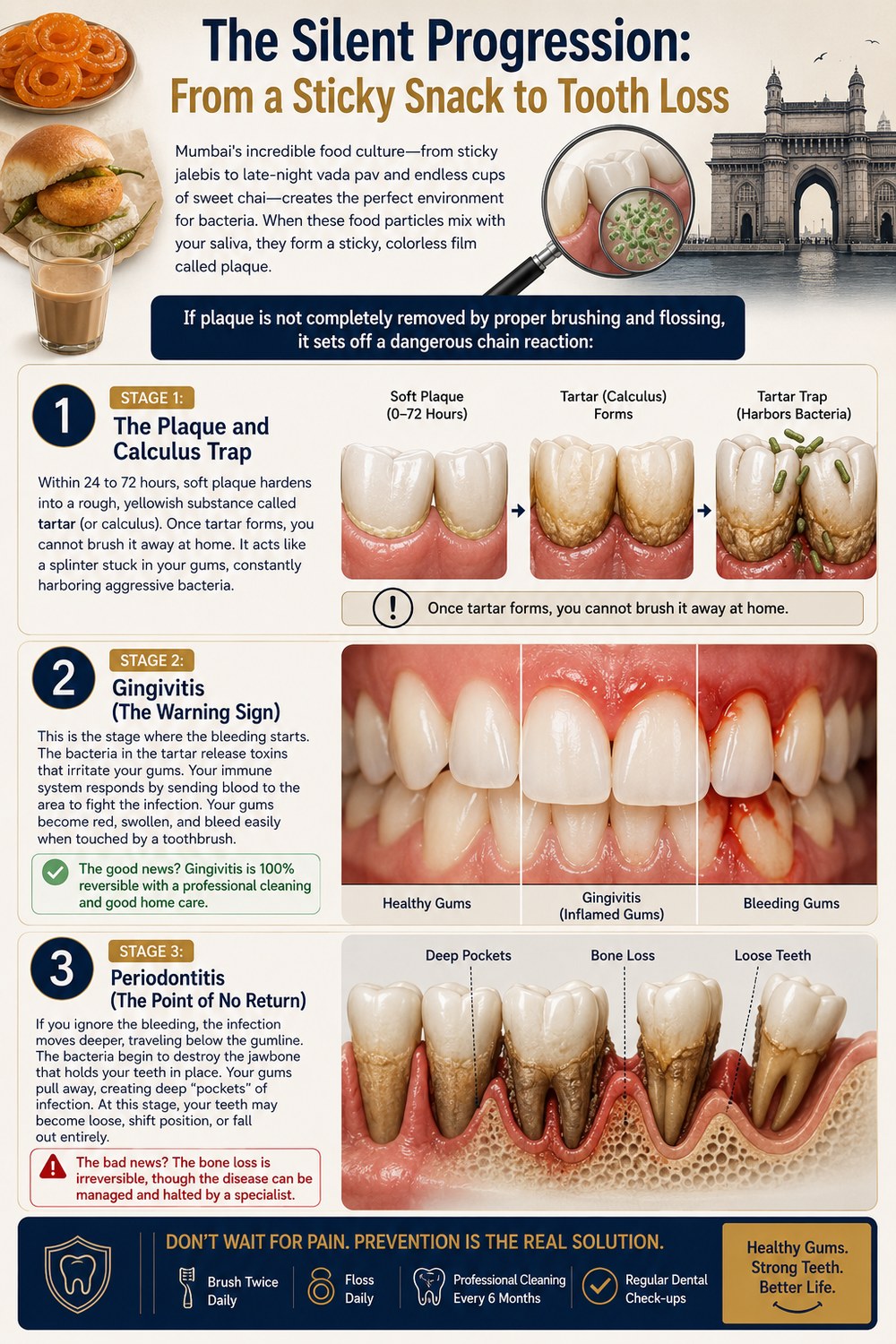
Mumbai's incredible food culture — from sticky jalebis to late-night vada pav and endless cups of sweet chai — creates the perfect environment for oral bacteria. When sugary food particles mix with saliva, they form a sticky colourless film called plaque. If plaque isn't fully removed by proper brushing and flossing, it sets off a dangerous chain reaction.
Stage 1: Plaque hardens into tartar (calculus)
Within just 24 to 72 hours, soft plaque calcifies into a rough yellowish-brown deposit called tartar or calculus. Once tartar forms, you cannot brush it away at home — no toothpaste, mouthwash or oil-pull can dissolve it. It clings to the tooth like a splinter stuck in your gums, constantly harbouring aggressive bacteria.
Stage 2: Gingivitis — the warning sign
This is the stage where the bleeding starts. The bacteria in the tartar release toxins that inflame the surrounding gum tissue. Your immune system responds by sending blood to the area to fight the infection — that's the bright pink swelling and the streak of red in your sink.
The good news: gingivitis is 100% reversible with a professional scaling and consistent home care. Treated at this stage, your gums fully recover within 1–2 weeks and there's no lasting damage.
Stage 3: Periodontitis — the point of no return
If you ignore the bleeding for months or years, the infection burrows below the gumline. The bacteria begin destroying the jawbone that anchors your teeth. Your gums pull away from the teeth, creating deep infected "pockets". Teeth may begin to feel loose, shift position, lengthen, or fall out entirely.
The bad news: the bone loss is irreversible. A specialist can halt the disease and stabilise the bite, but the lost bone never grows back to its original level.
Gingivitis vs Periodontitis: At a Glance
| Feature | Gingivitis | Periodontitis |
|---|---|---|
| Stage | Early, surface-level | Advanced, below the gumline |
| Symptoms | Red, swollen gums; bleeding when brushing or flossing; bad breath | Loose or shifting teeth; receding gums; pus; deep pockets; bite changes |
| Bone loss | None | Permanent — visible on X-ray |
| Reversible? | Yes — fully reversible | No — can only be halted, not reversed |
| Treatment | One scaling visit + home care | Deep cleaning (root planing); possibly surgery; lifelong maintenance |
| Typical cost in Mumbai | ₹1,000 – ₹2,500 | ₹3,000 – ₹15,000+ depending on severity |
The economics speak for themselves: early treatment is dramatically cheaper than late treatment.
Why Mumbaikars Make It Worse (Two Common Mistakes)
Patients constantly tell us either:
- "My gums bled, so I stopped brushing that area."
- "I switched to a hard-bristle toothbrush to scrub the infection away."
Both reactions make the disease worse:
- Avoiding the area lets plaque and tartar multiply rapidly. Within weeks the bleeding spreads to other teeth.
- Scrubbing aggressively traumatises the already inflamed tissue, causes the gums to recede, and exposes the sensitive yellow tooth roots underneath.
The only safe, effective fix is to remove the irritant (tartar) professionally.
The Fix: Ultrasonic Scaling
At Tru Smile Multi Specialty Dental Clinic, the most common treatment we provide for bleeding gums is ultrasonic scaling and polishing. Using a specialised high-frequency ultrasonic tool that pulses 25,000+ times per second combined with a fine water mist, we gently vibrate and flush away hardened tartar from above and below the gumline.
The procedure is:
- Painless for most patients (mild numbing available if you're particularly sensitive)
- 30 to 45 minutes for a routine case
- Followed by polishing to smooth the enamel pores so plaque has less surface to grip
- Capped with personalised brushing-and-flossing technique coaching so it doesn't come back
Most patients see the bleeding stop within 3–7 days of a single scaling.
Debunking the most common Indian dental myth
We hear this every single week: "Doctor, won't cleaning make my teeth loose or create gaps?"
Absolutely not. Scaling removes the harmful stone-like tartar that was artificially holding infected, mobile teeth together while simultaneously dissolving the bone underneath. Scaling does not damage enamel or create gaps. The "gaps" you sometimes feel after a cleaning are simply where the tartar used to fill the natural space between teeth and gums — once the tartar is gone, that space (which always existed) is exposed for a few days until the gums tighten back up. Within a week, your teeth feel stronger, cleaner and healthier.
When to See a Dentist Immediately
Routine bleeding when brushing means "book a scaling soon". But these symptoms mean don't wait:
- Spontaneous bleeding — gums bleeding when you're not brushing, eating or touching them
- Severe pain or throbbing in the gums or jaw
- Pus or a bad taste in your mouth that doesn't go with brushing
- A loose or shifting tooth in an adult (no tooth should ever feel mobile)
- Visible gum recession where teeth look longer than before, especially with sensitivity to hot and cold
- Persistent bad breath that brushing and mouthwash don't fix
- Swollen jaw or face
Any of these mean active periodontitis or possibly an abscess — call us on +91 98679 33139 the same day, or book an emergency consultation.
Special Cases: Bleeding Gums Are More Serious If…
Some groups need to take bleeding gums extra seriously because the same gum bacteria can affect their wider health:
Pregnant women — "pregnancy gingivitis"
Hormonal changes make gums significantly more sensitive to plaque during pregnancy. Bleeding gums in pregnancy are linked to higher risk of preterm birth and low birth weight, so a scaling in the second trimester is strongly recommended. The procedure is safe during pregnancy.
People with diabetes
Gum disease and diabetes feed each other. Poorly controlled blood sugar makes gum infections worse, and a chronic gum infection makes blood sugar harder to control. Diabetic patients should have a scaling every 4–6 months, not the typical 12.
Smokers and gutkha users
Tobacco masks the bleeding (nicotine constricts blood vessels), so smokers often discover advanced periodontitis only when teeth start to loosen. If you smoke or chew, don't rely on bleeding as your warning sign — get a scaling every 6 months regardless.
Patients on blood thinners (Aspirin, Warfarin, Eliquis, etc.)
Tell us before any scaling. We don't usually need to stop your medication, but we adjust technique so bleeding is well-controlled during and after the appointment.
How to Prevent Gum Disease: A Simple Daily Routine
After your scaling, this 4-step daily habit keeps gingivitis from coming back:
- Brush twice daily — morning and night, 2 full minutes. Use a soft-bristled brush (medium and hard bristles damage gums) and a fluoride toothpaste. Replace your brush every 3 months.
- Floss once daily, ideally before bedtime. If you've never flossed, expect a little bleeding for the first week — that's the gingivitis settling, not new damage. Persistent flossers are the people whose gums never bleed.
- Use a mouthwash with chlorhexidine for 2 weeks after a scaling, then switch to a regular fluoride mouthwash for daily use.
- Schedule a scaling every 6–12 months. Even with perfect home care, some tartar always forms in spots a brush can't reach (especially behind the lower front teeth).
That's it. Four small habits prevent the most common cause of tooth loss in adults worldwide.
Frequently Asked Questions
How can I stop bleeding gums immediately?
There's no genuine overnight cure. Warm salt-water rinses (½ teaspoon salt in a glass of warm water, swished for 30 seconds, twice daily) temporarily reduce swelling and soothe inflamed tissue. But the bleeding will not stop permanently until a dentist removes the hardened tartar causing the infection. Until then, keep brushing gently and don't avoid the bleeding area.
Are bleeding gums a sign of oral cancer?
In about 99% of cases, bleeding gums are caused by gingivitis or periodontitis — not cancer. Unexplained bleeding can rarely be a symptom of broader health issues (oral cancer, blood clotting disorders, vitamin deficiencies, leukaemia), so don't panic but do get a professional check-up to confirm the cause. Most patients feel hugely relieved after the consultation.
What is the best toothpaste for bleeding gums?
"Gum care" toothpastes contain mild astringents that temporarily shrink swollen blood vessels — they mask the symptom, not the disease. No toothpaste can dissolve hardened calculus. A regular fluoride toothpaste plus a professional scaling does far more than any specialised paste.
Will scaling make my teeth loose or create gaps?
No — this is the most persistent dental myth in India. Scaling removes the tartar that causes loose teeth and bone loss. The "gap" feeling for a few days after cleaning is simply the natural space between tooth and gum being exposed once the tartar is gone. Your gums tighten back up within a week and your teeth feel stronger, not weaker.
What's the difference between regular cleaning and deep cleaning?
A regular cleaning (scaling + polishing) treats plaque and tartar above the gumline and is for healthy gums or early gingivitis. A deep cleaning (scaling + root planing) goes below the gumline to clean out infected periodontal pockets — it's for established periodontitis. Deep cleaning is sometimes done in two visits with local anaesthesia and costs more.
Do you treat patients from Andheri, Goregaon and the western suburbs?
Yes. Tru Smile is on Sahakar Road in Jogeshwari West and treats patients from Andheri, Goregaon, Oshiwara, Bandra, Vile Parle and across the western suburbs. Many patients schedule their scaling on a Saturday alongside an annual check-up. See our contact page for directions.
Don't Wait Until It Hurts
Gum disease is famously a silent disease — it's rarely painful until the advanced stages. By the time your teeth hurt or feel loose, severe damage has already been done. If your gums bleed when you brush, spit, or eat hard foods like apples, listen to your body before it stops sending warnings.
A scaling visit takes less time than your morning chai routine and costs less than a dinner out. The alternative — ignoring it — costs you teeth.
Ready for healthy, pink gums?
- Call or WhatsApp: +91 98679 33139
- Book your scaling online: trusmiledentist.in/book/ — pick your slot in under a minute
- Visit: Shop No 11, Ruby Tower, Off S V Road, Sahakar Road, Jogeshwari West, Mumbai 400102
- Hours: Mon–Sat 10 AM – 1:30 PM and 5 PM – 9 PM · Sunday by appointment
- Meet our team: Tru Smile's specialists
19+ years in practice · 10,000+ happy patients · advanced sterilisation protocols.