Emergency Dentist in Jogeshwari: First-Aid Guide for Cracked Teeth, Severe Pain & Other Dental Emergencies
If you're in pain right now and need to be seen today, call us on +91 98679 33139. We keep emergency slots open every clinic day. Walk-in patients are welcome during our open hours (Mon–Sat 10 AM – 1:30 PM and 5 PM – 9 PM).
A dental emergency is one of the most stressful things that can happen — partly because the pain is usually intense, partly because most people don't know what to do in the first critical minutes. Should you go to a hospital emergency room? Should you wait until tomorrow? Is it safe to take a painkiller? Will the tooth be saved if you act fast?
This guide answers all of those questions. We'll walk through the 8 most common dental emergencies, give you clear step-by-step first aid for each, tell you which situations need a hospital ER instead of a dentist, and explain exactly how to reach our Jogeshwari West clinic when you need urgent care.
Save this page on your phone before you ever need it.
The 30-Minute Rule (Read This First)
If a permanent tooth has been knocked out completely — usually from a fall, sports injury, or accident — the first 30 minutes determine whether it can be saved. Everything else in this guide can wait. This cannot.
Step-by-step:
- Find the tooth. Pick it up by the crown (the white chewing surface) — never by the root. Touching the root damages the cells needed for re-attachment.
- Don't scrub it clean. If it's dirty, gently rinse with milk or saline (or clean tap water as a last resort) for no more than 10 seconds. Don't use soap, alcohol or any antiseptic.
- Try to put it back in the socket. This is the best storage medium for the tooth. Push it gently into place with clean fingers, then bite softly on a clean cloth or gauze to hold it there.
- If you can't re-implant it, store it in: - Cold milk (best easily available option) — or - Saline — or - The patient's own saliva (inside their cheek if they're old enough not to swallow it) - Never store a tooth in plain water — water damages the root cells in minutes
- Call us immediately on +91 98679 33139 and head straight to the clinic. The faster you arrive, the higher the chance of saving the tooth.
For baby (milk) teeth that have been knocked out: do not try to re-implant them. A re-implanted milk tooth can damage the developing permanent tooth underneath. Just bring the child in to be checked for injury to the gum or jawbone.
The 8 Most Common Dental Emergencies
1. Severe Toothache or Throbbing Pain
A toothache that builds over hours, throbs, keeps you awake, or radiates to the jaw or ear is usually one of three things: a deep cavity reaching the nerve, a cracked tooth, or a developing abscess. None of these will heal on their own.
Right now:
- Rinse with warm salt water (½ teaspoon salt in a glass of warm water) — temporarily reduces pressure and inflammation
- Take paracetamol or ibuprofen at a normal adult dose (avoid aspirin, which thins blood)
- Do not put a painkiller tablet directly on the gum or tooth — it burns the tissue
- Avoid hot or cold drinks on the affected side
- Sleep with the head slightly elevated (extra pillow) — reduces throbbing
Call us same-day if pain is severe, lingering, or accompanied by fever or facial swelling.
2. Cracked, Broken, or Chipped Tooth
A cracked tooth from biting hard food (kebab on the bone, hard chikki, ice), a fall, or sports usually needs same-day or next-day care to prevent the crack from getting worse.
Right now:
- Rinse your mouth with warm water
- If a piece of the tooth has broken off, save it in milk or saliva and bring it with you — sometimes it can be bonded back
- Apply a cold compress to the outside of the cheek if there's swelling
- Avoid chewing on that side
- Take a painkiller if needed
Call us same-day. Untreated cracks tend to grow and may eventually split the tooth in two — at which point it can no longer be saved.
3. Knocked-Out Tooth (Avulsed Tooth)
See The 30-Minute Rule above. This is the most time-sensitive dental emergency. Every minute matters.
4. Lost Filling or Crown
A filling that fell out usually isn't a dental emergency, but a lost crown can be uncomfortable and the exposed tooth becomes vulnerable to further damage.
Right now:
- Save the crown if you can find it — many crowns can be re-cemented (₹500–₹1,500)
- Cover the exposed tooth with dental wax (available at any chemist) or temporary filling material like Dentemp
- Avoid chewing on that tooth
- Sensitivity to cold or sweets is normal — keep the tooth dry-ish until you can get to the clinic
Call us within 1–3 days. Don't try to glue the crown back on with super-glue or any household adhesive — these are toxic and damage the tooth permanently.
5. Severe Facial or Gum Swelling
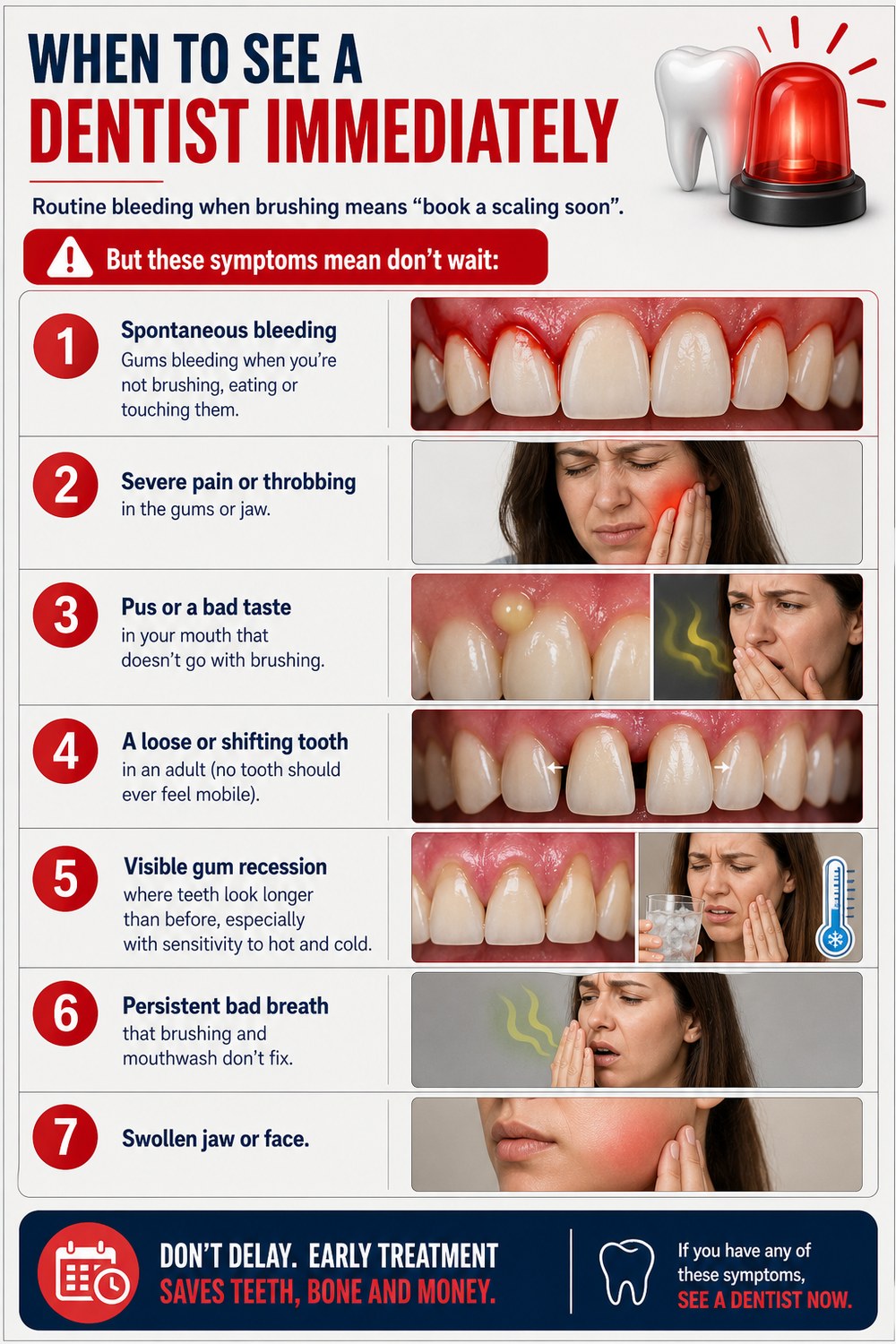
Swelling in the gum, cheek or lower jaw is a sign of an active infection — almost always a dental abscess. Don't wait this out.
Right now:
- Rinse with warm salt water several times
- Apply a cold compress to the outside of the cheek (not heat — heat makes infections spread faster)
- Take a painkiller if needed
- Call us same-day on +91 98679 33139
Go to a hospital ER instead if any of the following:
- Swelling is spreading rapidly toward the eye, throat, or under the jaw
- You have difficulty breathing or swallowing
- You have a high fever (>38.5°C / 101°F) along with swelling
- You feel unwell, dizzy, or confused
These are signs of a serious infection that may need IV antibiotics in a hospital setting.
6. Object Stuck Between Teeth
Bone fragments, fish-bone splinters, popcorn kernels and tough meat fibres can get firmly wedged between teeth — sometimes painfully so.
Right now:
- Try gentle dental floss between the teeth from the side, not from above (which can push the object deeper)
- Do not use a needle, pin, hairpin, or any sharp metal object — these damage the gum and can break off
- Rinse with warm salt water
If gentle flossing doesn't dislodge it within a few attempts, call us — we have specific tools to remove stuck objects safely without damaging the gum.
7. Bleeding That Won't Stop
After a tooth extraction or a mouth injury, light bleeding for 1–2 hours is normal. If it doesn't slow down significantly within 4 hours, or if it's heavy bleeding from a cut on the lip, tongue or cheek:
Right now:
- Bite firmly on a clean gauze pad or a folded clean cotton cloth for 20 minutes without checking — repeated checking dislodges the clot
- Sit upright, head slightly forward (not lying down — this fills the mouth with blood and causes nausea)
- Don't rinse, spit forcefully, or drink hot liquids — these dislodge the clot
- A wet black tea bag held against the bleeding site for 20 minutes helps clotting (tannins in tea constrict blood vessels)
If bleeding doesn't stop within 30–45 minutes of firm pressure, or if you're on blood thinners, call us or head to a hospital ER.
8. Wisdom Tooth Flare-Up
A partially erupted wisdom tooth can cause sudden severe pain, gum swelling, and difficulty opening the mouth — usually because food has impacted under the gum flap and triggered infection (called pericoronitis).
Right now:
- Rinse with warm salt water frequently — every 1–2 hours
- Take a painkiller (paracetamol or ibuprofen)
- Avoid chewing on that side
- Use a soft toothbrush gently in the area
Call us within 1–2 days. We'll examine the area, possibly clean it under local anaesthesia, prescribe antibiotics if there's spreading infection, and discuss whether the tooth needs to be removed.
When to Go to a Hospital ER Instead of a Dentist
A dentist is the right call for nearly all dental emergencies. But these specific situations need a hospital emergency room, not a dental clinic:
- Suspected jaw fracture after a major fall or accident (jaw doesn't open or close normally, severe deformity)
- Severe facial trauma with bleeding that won't stop
- Difficulty breathing or swallowing from facial swelling — possible airway obstruction
- High fever with rapidly spreading swelling — signs of serious infection
- Loss of consciousness or concussion after a head injury
- Uncontrolled bleeding in a patient on blood thinners
- Anaphylactic reaction to dental anaesthesia (rash, throat tightness, difficulty breathing)
In these cases, head to the nearest hospital with an emergency department. The closest options to Jogeshwari West are: Holy Spirit Hospital (Andheri), Cooper Hospital (Vile Parle), Kokilaben Dhirubhai Ambani Hospital (Andheri West), and Seven Hills Hospital (Andheri East).
Pain Management Before You Reach the Clinic
If you can't get to a dentist immediately, these are safe and effective options:
- Paracetamol (Crocin / Calpol) — 500–1000 mg every 6–8 hours, max 4 g per day. Safest first option. Safe in pregnancy.
- Ibuprofen (Brufen / Combiflam) — 400 mg every 6–8 hours with food. Reduces both pain and swelling. Avoid if you have stomach ulcers, kidney problems, or are in late pregnancy.
- Cold compress on the outside of the cheek, 15 minutes on / 15 minutes off
- Warm salt-water rinses every 2–3 hours
- Clove oil dabbed onto a cotton swab and held against the painful tooth (an old remedy that genuinely works — eugenol in clove is mildly anaesthetic). Don't swallow it.
What to avoid:
- Don't put aspirin (or any tablet) directly on the gum or tooth — chemical burns
- Don't apply heat to a swollen face — accelerates infection
- Don't drink alcohol "to numb the pain" — interferes with painkillers and antibiotics
- Don't smoke for 24+ hours — slows healing and worsens pain
- Don't take painkillers for more than 2–3 days without seeing a dentist — you're masking, not treating
What to Bring to Your Emergency Appointment
If you have time before you leave, gather:
- Government ID (Aadhaar / PAN / Driving licence) for first-time visits
- A list of your current medications including blood thinners, blood pressure medication, diabetes medication
- Any drug allergies (especially to antibiotics or anaesthetics)
- The broken tooth piece, knocked-out tooth, or lost crown if you have it
- Recent X-rays if you've been to another clinic for the same tooth
- For trauma cases — the time of injury and what happened (helps us assess soft-tissue damage)
If it's a true emergency — knocked-out tooth, severe trauma, spreading infection — just come. We'll handle paperwork later.
Cost of Common Emergency Dental Procedures in Mumbai
We believe in transparent pricing even for emergencies — you should never have to negotiate while you're in pain. Typical Mumbai ranges:
- Emergency consultation + exam: ₹500 – ₹1,500
- X-ray: ₹200 – ₹500
- Pain management + temporary filling: ₹1,000 – ₹2,500
- Tooth re-implantation (knocked-out tooth): ₹3,000 – ₹8,000 (includes splinting; root canal usually needed later)
- Crown re-cementation: ₹500 – ₹1,500
- Lost filling — replacement: ₹1,000 – ₹3,000
- Tooth extraction: ₹1,500 – ₹5,000 (depending on complexity)
- Surgical wisdom tooth removal: ₹4,000 – ₹12,000
- Abscess drainage + antibiotics: ₹1,500 – ₹3,000
- Root canal (when emergency reveals deep nerve damage): ₹4,000 – ₹8,000
We give you a clear written quote before starting any treatment — no surprises after the work is done.
Out-of-Hours and Weekend Emergencies
Our regular hours are Mon–Sat 10 AM – 1:30 PM and 5 PM – 9 PM, with Sundays by appointment. For dental emergencies during these hours, walk-in patients are welcome.
For emergencies outside these hours:
- WhatsApp +91 98679 33139 — we monitor messages outside hours and respond as quickly as we can with first-aid guidance and the next available appointment time
- For severe trauma or signs of serious infection (rapid swelling, breathing difficulty, high fever) — go to the nearest hospital ER (see hospital list above)
- For knocked-out teeth at night — re-implant if possible, store in milk, and get to us first thing in the morning. The 30-minute rule still applies but successful re-implantation is possible up to a few hours later if the tooth has been kept in milk
Frequently Asked Questions
How quickly can I be seen for a dental emergency?
We keep daily emergency slots reserved for walk-in cases. During open hours you can usually be seen within 15–30 minutes of arrival. For knocked-out teeth and severe trauma, we'll fit you in immediately. Call ahead on +91 98679 33139 so we can prepare.
Can a knocked-out tooth really be saved?
Yes — but only if you act fast. If the tooth is re-implanted within 30 minutes and stored properly until then, the success rate is over 90%. After 1 hour without proper storage, success drops sharply. After 4–6 hours, re-implantation is rarely successful. The key is the first 30 minutes — store in milk or saliva, never water, and head straight to a dentist.
Will an emergency visit be more expensive than a routine one?
The procedures themselves cost the same as scheduled appointments — we don't charge "emergency surcharges". The only thing different is the consultation may be slightly higher (₹500–₹1,500 vs the routine ₹500) because we work around our scheduled patients to fit you in. We always give you a written quote before starting.
Do I need to be an existing patient to come in for an emergency?
No. We accept emergency walk-ins regardless of whether you've been to us before. Bring a government ID and any current X-rays or medication list if you have them. If you're in active pain or trauma, just come — paperwork can wait.
Can I take antibiotics from a previous prescription if I think I have an infection?
No. This is one of the most common dangerous mistakes patients make. Self-prescribing antibiotics can mask the infection without treating it properly, contribute to antibiotic resistance, and cause adverse reactions. The infection still needs the underlying tooth issue addressed (drainage, root canal, or extraction) — antibiotics alone almost never resolve a dental abscess. Come in for proper evaluation.
Do you accept emergency patients from Andheri, Bandra, Goregaon and the western suburbs?
Yes. Tru Smile is centrally located on Sahakar Road in Jogeshwari West, easily reached from Andheri, Bandra, Goregaon, Oshiwara, Vile Parle and the western suburbs. We're 5 minutes from S V Road, 10 minutes from the Western Express Highway, and accessible from Jogeshwari and Andheri stations. See our contact page for directions and parking.
When in Doubt, Call
The single biggest mistake patients make in dental emergencies is waiting too long. A small fix today is a big problem tomorrow. A toothache that "settles" overnight often returns as an abscess. A small crack ignored for a month becomes a tooth that has to be extracted.
If you're not sure whether your situation is an emergency, just call. A 2-minute conversation will tell you whether you need to be seen today, tomorrow, or in a routine appointment next week.
In a dental emergency right now?
- Call or WhatsApp: +91 98679 33139 — we'll respond same-day
- Walk in: Shop No 11, Ruby Tower, Off S V Road, Sahakar Road, Jogeshwari West, Mumbai 400102
- Hours: Mon–Sat 10 AM – 1:30 PM and 5 PM – 9 PM · Sunday by appointment · WhatsApp monitored outside hours
- Book a non-urgent appointment online: trusmiledentist.in/book/
- Meet our team: Tru Smile's specialists
19+ years in practice · 10,000+ happy patients · advanced sterilisation protocols · same-day emergency slots reserved every clinic day.