At What Age Should Your Child See a Dentist? A Mumbai Parent's Simple Guide to the First Visit
It's a typical Mumbai parent moment. Your three-year-old is happily eating a chocolate after a long Diwali week, and you suddenly notice a black spot on a back tooth. Your mother says "don't worry, it's a milk tooth — it'll fall out." Your sister-in-law in the family WhatsApp group says "my dentist took my son at age 5, no need to rush." And somewhere on Instagram, a paediatric dentist is saying "first visit by the first birthday."
So which is it? When should you actually take your child to the dentist for the first time?
This guide gives you the clear, simple answer — backed by global paediatric dental guidelines — and walks you through what to expect at every age, what to watch for at home, and the most common Mumbai-parent worries (bottle cavities, thumb-sucking, sweet-loving children) honestly addressed.
The Short Answer: First Visit by Age 1
Both the American Academy of Pediatric Dentistry and the Indian Society of Pedodontics and Preventive Dentistry recommend the same thing:
Your child's first dental visit should be by their first birthday — or within 6 months of the first tooth appearing, whichever comes first.
This usually surprises parents because at age 1 most children only have a handful of front teeth and no obvious problems. But that's exactly the point. The first visit isn't about fixing anything. It's about:
- Catching any early issues (like bottle decay) before they become painful
- Teaching parents how to clean baby teeth properly
- Discussing fluoride, diet, thumb-sucking, pacifier use
- Most importantly — building a positive relationship with the dentist before there's a problem
A child whose first visit is at age 6 because of a painful cavity often becomes a lifelong dental-phobic adult. A child whose first visit is at age 1 — for a fun "ride in the chair", a tooth count, and a sticker — usually grows up unafraid.
Dental Milestones: What to Expect at Every Age
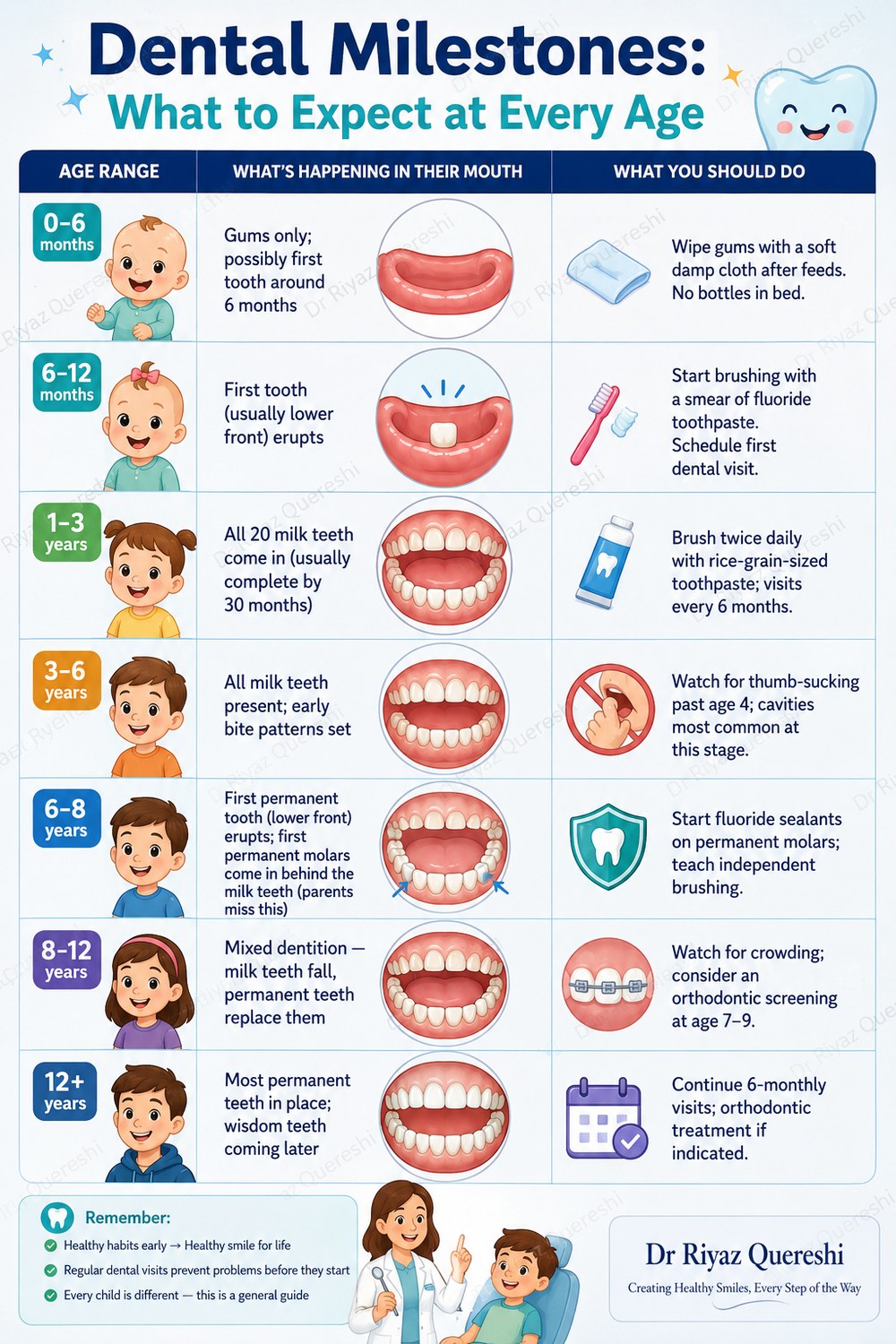
| Age range | What's happening in their mouth | What you should do |
|---|---|---|
| 0–6 months | Gums only; possibly first tooth around 6 months | Wipe gums with a soft damp cloth after feeds. No bottles in bed |
| 6–12 months | First tooth (usually lower front) erupts | Start brushing with a smear of fluoride toothpaste. Schedule first dental visit |
| 1–3 years | All 20 milk teeth come in (usually complete by 30 months) | Brush twice daily with rice-grain-sized toothpaste; visits every 6 months |
| 3–6 years | All milk teeth present; early bite patterns set | Watch for thumb-sucking past age 4; cavities most common at this stage |
| 6–8 years | First permanent tooth (lower front) erupts; first permanent molars come in behind the milk teeth (parents miss this) | Start fluoride sealants on permanent molars; teach independent brushing |
| 8–12 years | Mixed dentition — milk teeth fall, permanent teeth replace them | Watch for crowding; consider an orthodontic screening at age 7–9 |
| 12+ years | Most permanent teeth in place; wisdom teeth coming later | Continue 6-monthly visits; orthodontic treatment if indicated |
Why the First Visit Matters More Than Most Parents Realise
1. Cavities can start before age 2
The most common preventable disease in Indian children isn't asthma or allergies — it's early childhood caries, often called "bottle decay" or "nursing caries". Children who fall asleep with a bottle of milk (or worse, juice or sugar water) develop a distinctive pattern of decay on the front teeth that can be advanced by age 2 or 3. By the time the parent notices, the front teeth may need crowns or extractions under general anaesthesia.
A first visit at age 1 catches this risk before it becomes damage.
2. "But they'll fall out anyway" is the most expensive myth in Indian parenting
Milk teeth are not disposable. They:
- Hold space for permanent teeth — losing a milk tooth too early causes the next teeth to drift in, creating crowding that needs braces later
- Are needed for chewing — a child with painful or missing milk teeth eats less, and nutrition suffers right when growth is fastest
- Affect speech development — front teeth in particular shape how a child learns to pronounce sounds
- Can cause infections that affect the developing permanent tooth beneath them
Treating a milk tooth costs ₹500–₹2,500. Extracting it and treating the consequences later (space-maintainer, then orthodontics) can cost ₹50,000+. The "they'll fall out anyway" approach is a false economy.
3. Bite problems are easiest to catch early
If your child has a finger-sucking habit, an open bite, an underbite, a crossbite or jaw asymmetry, age 7–9 is the ideal window for early intervention — not age 14. Many issues that need full braces at 14 can be corrected with a small functional appliance worn for 6–12 months at age 8.
This is why the Indian Society of Pedodontics recommends an orthodontic screening by age 7, even if everything seems fine.
What Happens at a Child's First Dental Visit
Many parents are anxious about the first visit. Will the child cry? Will they need a filling on day one? Will it traumatise them? Here's what actually happens at our Jogeshwari clinic:
- Knee-to-knee exam (under age 3). The child sits on your lap; the dentist sits opposite, knees touching. The child's head rests in the dentist's lap for a quick, gentle look. Total examination time: 1–2 minutes.
- A tooth count and a "ride" in the chair (3+ years). Older children sit in the chair themselves. They get to push the buttons, see the suction, hear the chair go up and down — making the equipment fun, not scary.
- A gentle clean and fluoride application if needed and if the child is comfortable.
- Parent education time. This is honestly the most important part. We discuss feeding, cleaning technique, fluoride toothpaste amount, when to start flossing, snack habits, and any specific concerns.
- A sticker, a small toy, or a "brave certificate" at the end — first impressions matter.
No fillings or extractions on the first visit unless there's an emergency. The whole goal is to build trust.
Common Mumbai Parent Concerns — Honestly Answered
"My child eats so many sweets — Diwali, birthdays, school tiffin trades…"
The frequency of sugar matters far more than the amount. One large sweet eaten at the end of a meal causes far less damage than 5 small sweets spread across the day. After every sugary snack, the mouth's pH drops and stays acidic for ~30 minutes. Five small snacks = 2.5 hours of acid attack a day. One Diwali sweet plus a glass of water afterwards = 30 minutes.
Practical rules: - Save sweets for after meals, not as snacks between - Rinse the mouth with water immediately after - Avoid letting a sweet linger (lollipops, chocolates that melt slowly) - No sweets in the last 30 minutes before bed — saliva flow drops at night and can't wash away the sugar
"My toddler still uses a feeding bottle at night"
This is the #1 cause of early childhood cavities in Indian children. By age 12 months, transition night feeds to a sippy cup of plain water. Milk before bedtime is fine — but it should be followed by a wipe of the gums or a brush, and the bottle shouldn't be used as a sleep prop. We can guide you through the transition gently at the first visit.
"My child still sucks his thumb at age 5"
Thumb-sucking before age 3 rarely causes lasting damage — most children stop on their own. After age 4–5, persistent sucking begins to affect the developing bite (creating an open bite or pushing the upper front teeth forward). Don't shame the child — most habits are stress-related. We use gentle reminder appliances and positive-reinforcement techniques that work without making the child anxious.
"Should my child use fluoride toothpaste?"
Yes — but in the right amount.
- Under 3 years: a tiny smear (size of a grain of rice)
- 3–6 years: a small pea-sized amount
- 6+ years: full pea-sized amount, child can rinse and spit
The fluoride amount in modern Indian children's toothpastes (1000 ppm) is safe and dramatically reduces cavities. Skipping fluoride is a common mistake driven by social media misinformation.
"Are dental X-rays safe for my child?"
Modern digital paediatric X-rays use about 1/10th the radiation of older film X-rays — less than a single international flight. We only take X-rays when clinically needed (suspected hidden cavity between teeth, trauma, missing tooth check). The safety record is excellent. We explain exactly why an X-ray is needed before taking one, never as a routine billing add-on.
When to See a Dentist Immediately (Don't Wait for the Next Check-Up)
Most paediatric dental issues can wait for a routine appointment. These cannot:
- Tooth knocked out (especially a permanent tooth — the first 30 minutes are critical)
- Severe toothache keeping the child awake or causing them to refuse meals
- Visible swelling on the face or gums, especially with fever
- Trauma to the mouth with bleeding that doesn't stop in 10 minutes
- A dark spot on a tooth that wasn't there before — even if the child says it doesn't hurt
- A loose adult tooth at any age
For any of the above, call us same-day on +91 98679 33139.
Cost of Pediatric Dental Care in Mumbai
We believe in transparency, especially for parents already managing school fees, after-school activities and household budgets:
- First consultation and full exam: ₹500 – ₹1,500 (often free at our Jogeshwari clinic for the first paediatric visit)
- Routine cleaning and fluoride application: ₹1,000 – ₹2,500
- Fluoride sealant on a permanent molar (highly preventative): ₹1,000 – ₹2,000 per tooth
- Filling on a milk tooth: ₹800 – ₹2,500 depending on size
- Pulpectomy / pulp treatment (root canal on a milk tooth): ₹2,500 – ₹5,000
- Stainless-steel crown (cap on a damaged milk tooth): ₹2,000 – ₹4,500
- Space maintainer (for an early-lost milk tooth): ₹3,000 – ₹6,000
A single ₹1,500 sealant prevents the need for a ₹5,000 filling later. Prevention is by far the cheapest option.
Frequently Asked Questions
Should my baby go to the dentist before they have any teeth?
If your baby is approaching their first birthday, yes. Even toothless gums can have early issues like oral thrush, frenum tightness (tongue-tie / lip-tie) or unusual jaw development. The first visit is also the best time for parents to learn proper cleaning technique before teeth arrive.
How often should children visit the dentist?
Every 6 months for routine check-ups, the same as adults. Children with high cavity risk (history of decay, lots of sweets, special-needs cases) may benefit from 4-monthly visits.
My child is terrified of dentists — what can I do?
First, don't transmit your own dental anxiety — children pick up parental nervousness instantly. Avoid words like "injection", "drill" or "hurt" before the visit. We use child-specific language, distraction techniques, gentle pacing and (when needed) inhalation sedation with nitrous oxide ("laughing gas") which is completely safe and helps anxious children stay calm. The first visit being a positive experience matters more than getting any treatment done that day.
Can milk-tooth cavities affect my child's permanent teeth?
Yes. Untreated decay in a milk tooth can spread to the developing permanent tooth beneath it, causing yellowed or pitted permanent teeth, or in severe cases, infection that delays eruption. This is why "they'll fall out anyway" is dangerous advice.
When should my child start brushing on their own?
Children can start brushing themselves around age 3, but most lack the dexterity to brush thoroughly until age 7 or 8. Until then, parents should brush for them at least once a day (usually before bed) and supervise the morning brush. A good rule: if they can tie their own shoelaces neatly, they can brush thoroughly.
Do you treat children from Andheri, Bandra, Goregaon and the western suburbs?
Yes. Dr Nikita Lobo leads our paediatric dentistry department at our Jogeshwari West clinic and treats children from across Andheri, Bandra, Goregaon, Oshiwara, Vile Parle and the western suburbs of Mumbai. Our clinic has a child-friendly waiting area and we schedule paediatric appointments for times when your child is at their best (usually mornings). See our contact page for directions.
Build Lifelong Habits Now — Not After the First Cavity
The single biggest predictor of a lifetime of healthy teeth isn't fluoride toothpaste, isn't genetics, isn't even diet. It's whether the first dental memory is positive or scary.
A child who associates the dentist with stickers, friendly conversation and gentle care grows up confident and proactive about their oral health. A child whose first memory is pain, an emergency, or a frightening procedure grows up avoiding dental care entirely — sometimes for decades.
You have a one-time chance to set that pattern. Use it well.
Ready to book your child's first dental visit?
- Call or WhatsApp: +91 98679 33139
- Book online: trusmiledentist.in/book/ — pick your slot in under a minute
- Visit: Shop No 11, Ruby Tower, Off S V Road, Sahakar Road, Jogeshwari West, Mumbai 400102
- Hours: Mon–Sat 10 AM – 1:30 PM and 5 PM – 9 PM · Sunday by appointment
- Meet our paediatric dentist: Dr Nikita Lobo and the Tru Smile team
- See our paediatric dental services: Tru Smile services
19+ years in practice · 10,000+ happy patients · advanced sterilisation protocols · child-friendly clinic.