Dental Implants vs Dentures: A Simple Mumbai Guide to Replacing Missing Teeth
If you're reading this, there's a good chance you're trying to help a parent — or yourself — make one of the bigger decisions in adult dentistry: what to do about missing teeth?
It usually starts the same way. Your mother covers her mouth in family photos. Your father avoids peanut chikki at Diwali. A grandparent quietly switches from chapati to softer rice and dal because chewing has become a problem. The dentist says you have two options — dental implants or dentures — and the brochures make both sound great.
This guide explains the real difference in plain language. No jargon, no hidden costs, just the honest version of what each option does for you (or your parents), how long it lasts, what it costs in Mumbai, and which one suits which situation.
The 30-Second Difference
The simplest way to understand it:
- Dentures are removable teeth. You take them out at night, soak them, and put them back in the morning. They sit on top of your gums.
- Dental implants are permanent teeth. A small titanium screw is placed inside your jawbone (acting like an artificial root), and a new tooth is fixed onto it. You brush them like normal teeth and never take them out.
That single difference — fixed vs removable — drives almost every other comparison: comfort, chewing power, bone health, cost, lifespan and how natural they feel.
Implants vs Dentures: At a Glance
| Feature | Dental Implants | Removable Dentures |
|---|---|---|
| What they are | Permanent fixed teeth on titanium roots | Plastic + acrylic teeth that sit on the gums |
| Removable? | No — they stay in 24/7 | Yes — taken out at night |
| Chewing power | 90–95% of natural teeth — chapati, peanut chikki, hard fruit, all fine | 25–30% of natural teeth — soft food only |
| Affects taste? | No — palate is uncovered | Often yes — upper denture covers the roof of the mouth |
| Bone health | Preserves jawbone like a real tooth | Jawbone shrinks over years (face looks sunken) |
| Lifespan | 20+ years; often lifetime | 5–8 years; needs relines and remakes |
| Daily care | Brush + floss like normal teeth | Remove, soak, brush separately every night |
| Initial cost (Mumbai) | ₹25,000 – ₹60,000+ per tooth | ₹8,000 – ₹50,000 per full arch |
| Treatment time | 3–6 months total (mostly waiting) | 2–3 weeks |
| Best for | Anyone with healthy gums and enough bone | Patients with limited budget or unfit for surgery |
Dental Implants — Permanent, Comfortable, Most Natural
A dental implant is a small titanium screw — usually about the size of a screw you'd see in a wall plug — that's gently placed into your jawbone. Over the next 3–4 months, your bone naturally grows around the titanium and locks it in place permanently (this fusion is called osseointegration — the same process that makes a hip replacement work).
Once it's locked in, we attach a custom-made ceramic tooth on top. The result looks, feels and chews just like a real tooth. You can't tell it apart from your natural teeth in the mirror.
Why patients love them:
- You forget they're there. No clicking, no slipping, no taking them out at night.
- You eat what you want. Chapati straight off the tava, sugarcane, hard nuts, sticky jalebi — nothing's off the menu.
- They protect your jaw. This is the underrated benefit. Once a tooth is missing, the jawbone in that area starts shrinking within months — that's why long-term denture wearers develop the "sunken face" look. An implant stimulates the bone the way a natural tooth root does, and the bone stays.
- They last decades. Most implants placed correctly last 20+ years. Many are still functioning 30–40 years after placement.
The honest tradeoffs:
- Higher upfront cost than dentures.
- Surgery is required. It's a small procedure under local anaesthesia (similar discomfort to a tooth extraction), but it is surgery.
- You need enough bone. If teeth have been missing for years and the jawbone has already shrunk, a small bone graft may be needed first.
- Treatment is slower. Total time from placement to final tooth is usually 3–6 months because we wait for the bone to fuse properly. Worth the wait.
Removable Dentures — The Traditional, Affordable Option
Dentures have been around for over a century and still do their job for the right patient. They're a set of plastic teeth on a custom-fitted gum-coloured base that you wear during the day and take out to clean at night.
Why some patients still choose dentures:
- Lower upfront cost — by far the most affordable option for replacing many teeth at once.
- No surgery — useful if you have medical conditions that make implant surgery risky.
- Quick to make — usually ready in 2–3 weeks.
- Familiar — many older Indians grew up watching parents wear them and feel comfortable with the idea.
The honest tradeoffs:
- Reduced chewing power. Most denture wearers chew at about a quarter of natural-tooth strength. Hard foods (chikki, sugarcane, raw carrot, almonds) become very difficult.
- Slipping and clicking. Even well-fitted dentures can shift while talking or eating — especially in social situations.
- The upper denture covers the palate, which dulls the taste of food.
- Jawbone shrinks underneath them. This is why dentures need to be "relined" every 1–2 years and fully remade every 5–8 — not because they wear out, but because your jaw shape changes.
- Cleaning routine. Out at night, soaked in solution, brushed separately.
The Hidden Issue: What Happens to Your Jawbone
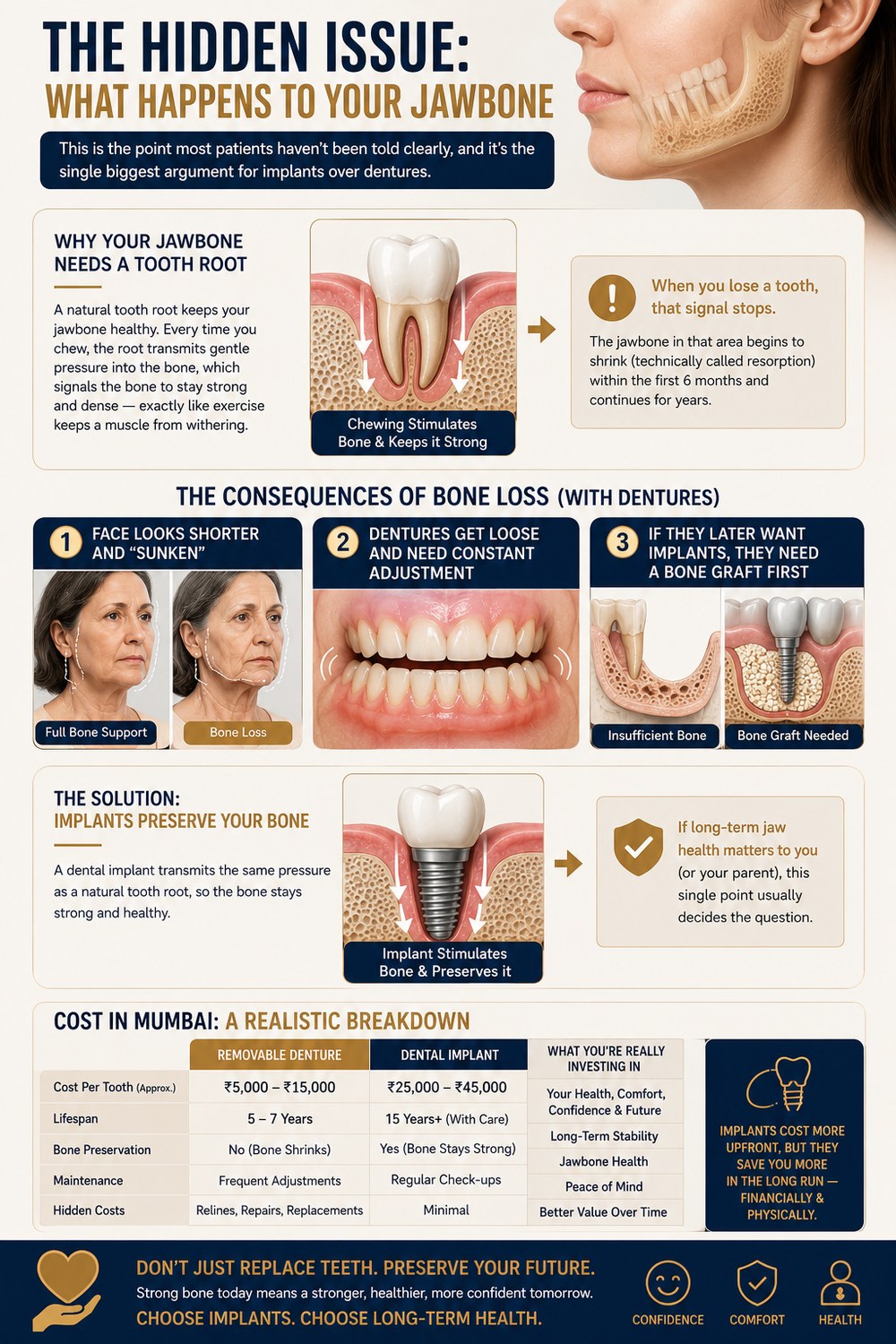
This is the point most patients haven't been told clearly, and it's the single biggest argument for implants over dentures:
A natural tooth root keeps your jawbone healthy. Every time you chew, the root transmits gentle pressure into the bone, which signals the bone to stay strong and dense — exactly like exercise keeps a muscle from withering.
When you lose a tooth, that signal stops. The jawbone in that area begins to shrink (technically called resorption) within the first 6 months and continues for years. After 5–10 years of dentures, many patients have lost so much bone that:
- Their face looks shorter and "sunken"
- Their dentures get loose and need constant adjustment
- If they later want implants, they need a bone graft first
A dental implant transmits the same pressure as a natural tooth root, so the bone stays. If long-term jaw health matters to you (or your parent), this single point usually decides the question.
Cost in Mumbai: A Realistic Breakdown
Honest ranges from clinics across Mumbai (Jogeshwari, Andheri, Bandra, Goregaon, South Bombay):
Dental implants:
- Single tooth implant (titanium implant + abutment + ceramic crown): ₹25,000 – ₹60,000+ depending on brand. Premium Swiss/German systems (Straumann, Nobel Biocare) cost more; Korean systems (Osstem, Dentium) are excellent value.
- Full upper or lower jaw — All-on-4 / All-on-6 implants: ₹2,00,000 – ₹7,00,000+ per arch for the complete set with 4–6 implants and a fixed bridge of teeth.
- Implant-retained denture (overdenture): ₹1,50,000 – ₹3,00,000 per arch — combines 2–4 implants with a removable denture that snaps onto them. A great middle option.
Dentures:
- Acrylic complete denture (full upper or lower): ₹8,000 – ₹20,000 per arch — the most affordable option.
- Flexible (BPS / valplast) dentures: ₹15,000 – ₹35,000 per arch — lighter, no metal, more comfortable.
- Premium denture with porcelain teeth: ₹25,000 – ₹50,000+ per arch.
We give a transparent written quote at the consultation — including any preliminary work like bone grafts or extractions if needed.
"Can My 70-Year-Old Parent Get Implants?"
Yes — age alone is almost never a reason to rule out implants. We've placed implants successfully on patients in their 70s and 80s. What matters is general health, not the number on the calendar.
The questions we actually consider:
- Diabetes — well-controlled diabetes (HbA1c under 7) is fine. Uncontrolled diabetes slows healing and is a real concern.
- Smoking — significantly reduces success rate. We recommend quitting at least 2 weeks before surgery and 8 weeks after.
- Blood thinners and recent heart attacks/strokes — we coordinate with the patient's cardiologist; usually no need to stop the medication.
- Bone density — osteoporosis isn't a deal-breaker, but bisphosphonate medications (Fosamax, etc.) need to be reviewed first.
- Medical fitness for a minor procedure — anyone fit enough for a small dental extraction is usually fit for an implant.
The patient's quality of life often improves more dramatically at age 70 than at 30 — they regain the ability to eat the foods they grew up loving and stop being self-conscious in family photos.
Eating Indian Food: Implants vs Dentures
A practical Mumbai-specific reality check most blogs miss:
| Food | With implants | With dentures |
|---|---|---|
| Chapati / phulka | Eat normally | Possible but slow; some tearing technique needed |
| Peanut chikki / hard sweets | Fine | Almost impossible |
| Sugarcane | Fine | Avoid |
| Vada pav crust | Fine | Difficult; soggy preferred |
| Almonds, cashews | Fine | Very limited |
| Bhel puri, chaat | Fine | Sticky elements problematic |
| Apple, raw carrot | Fine | Cut into small pieces, soft only |
| Bone-marrow nihari | Fine | Manageable |
| Soft khichdi, dal-rice, idli | Fine | Fine |
If your parent has stopped eating their favourite foods, that's a quality-of-life change worth investing to fix.
Frequently Asked Questions
How long does an implant procedure take?
The implant placement itself takes about 45–60 minutes per tooth under local anaesthesia — similar to a tooth extraction. After placement, your bone fuses with the implant over 3–4 months, then the final crown is fitted in a final 1-hour appointment. Total time: 3–6 months start-to-finish, but most of that is waiting at home.
Are dental implants painful?
No — the procedure is done under local anaesthesia and most patients are surprised at how comfortable it is. Mild soreness for 2–3 days afterwards (similar to a tooth extraction) is normal and easily managed with paracetamol or ibuprofen. Most patients return to work the next day.
Can dentures be made permanent?
Sort of — that's exactly what an implant-supported (snap-on) denture does. Two to four implants are placed in the jaw, and your denture clips onto them like LEGO. It's removable for cleaning but doesn't slip while eating or talking. A great middle-ground option for patients who can't afford a full set of individual implants.
How long do dentures last?
Acrylic dentures typically last 5–8 years before they need to be remade — not because they wear out, but because your jawbone shape changes over time as it shrinks underneath them. You'll usually need a "reline" (refit) every 1–2 years to keep them snug.
Will my new teeth look obviously fake?
No. Modern implant crowns are made of layered ceramic that mimics the translucency and shading of natural enamel. We use shade-matching software and a digital "smile preview" so you see exactly how the final tooth will look before any work is done. Most patients' family members can't tell which tooth is the implant.
Do you treat patients from Andheri, Bandra, Goregaon and South Bombay?
Yes. Tru Smile is on Sahakar Road in Jogeshwari West and treats implant patients from across the western suburbs and South Bombay. Out-of-area patients usually combine the consultation, surgery and final crown into 3 visits over 4 months. See our contact page for directions.
So — Implants or Dentures?
A simple decision framework:
- Choose implants if you have healthy gums, a generally healthy body, and want a permanent solution that protects your jawbone and lets you eat normally for the rest of your life. Especially if you (or your parent) are still active and care about quality of life.
- Choose dentures if budget is the primary constraint, surgery isn't an option for medical reasons, or you only need a temporary solution while planning longer-term treatment.
- Choose an implant-supported denture as the middle path — fewer implants, lower cost than a full set, but most of the comfort and stability of fixed teeth.
Most importantly — talk to a dentist, not a brochure. Your bone density, gum health, medical history and personal goals all matter.
Ready to discuss your or your parent's options?
- Call or WhatsApp: +91 98679 33139
- Book a consultation online: trusmiledentist.in/book/
- Visit: Shop No 11, Ruby Tower, Off S V Road, Sahakar Road, Jogeshwari West, Mumbai 400102
- Hours: Mon–Sat 10 AM – 1:30 PM and 5 PM – 9 PM · Sunday by appointment
- See our cosmetic & restorative services: Tru Smile services
- Meet our team: Tru Smile's specialists
19+ years in practice · 10,000+ happy patients · advanced sterilisation protocols.