Clear Aligners vs Braces for Adults: A Simple Mumbai Dentist's Guide to Straightening Teeth
You're 28, 35, or 50. You've made peace with the slightly crooked front teeth or the small gap that's been there since school. But lately you've been noticing it in every selfie. A cousin's wedding is coming up. You've started a new corporate role. Or you simply realised — if not now, when?
Adult orthodontics in Mumbai has quietly exploded over the last five years. What used to be a "kids only" thing — wire braces with metal brackets — now has a sleek, almost-invisible alternative: clear aligners (popularly known as Invisalign, though there are several brands).
So which one is actually right for you? This guide breaks down both options in plain language — comfort, timelines, real Mumbai costs, lifestyle differences, and when the cheaper option is genuinely the smarter choice.
What's the Actual Difference?
The simplest version:
- Traditional braces are small metal or ceramic brackets glued to the front of your teeth, connected by a thin wire that gradually tightens to move your teeth into place. You can see them when you smile. They stay on 24/7 for the full treatment.
- Clear aligners are a series of clear plastic trays — like very thin mouthguards — custom-shaped for your teeth. You wear each tray for 1–2 weeks, then switch to the next, and your teeth move slowly into the right position. They're nearly invisible, and you take them out to eat and brush.
Both achieve the same goal — straight teeth. They just take different paths to get there, and they suit different lifestyles.
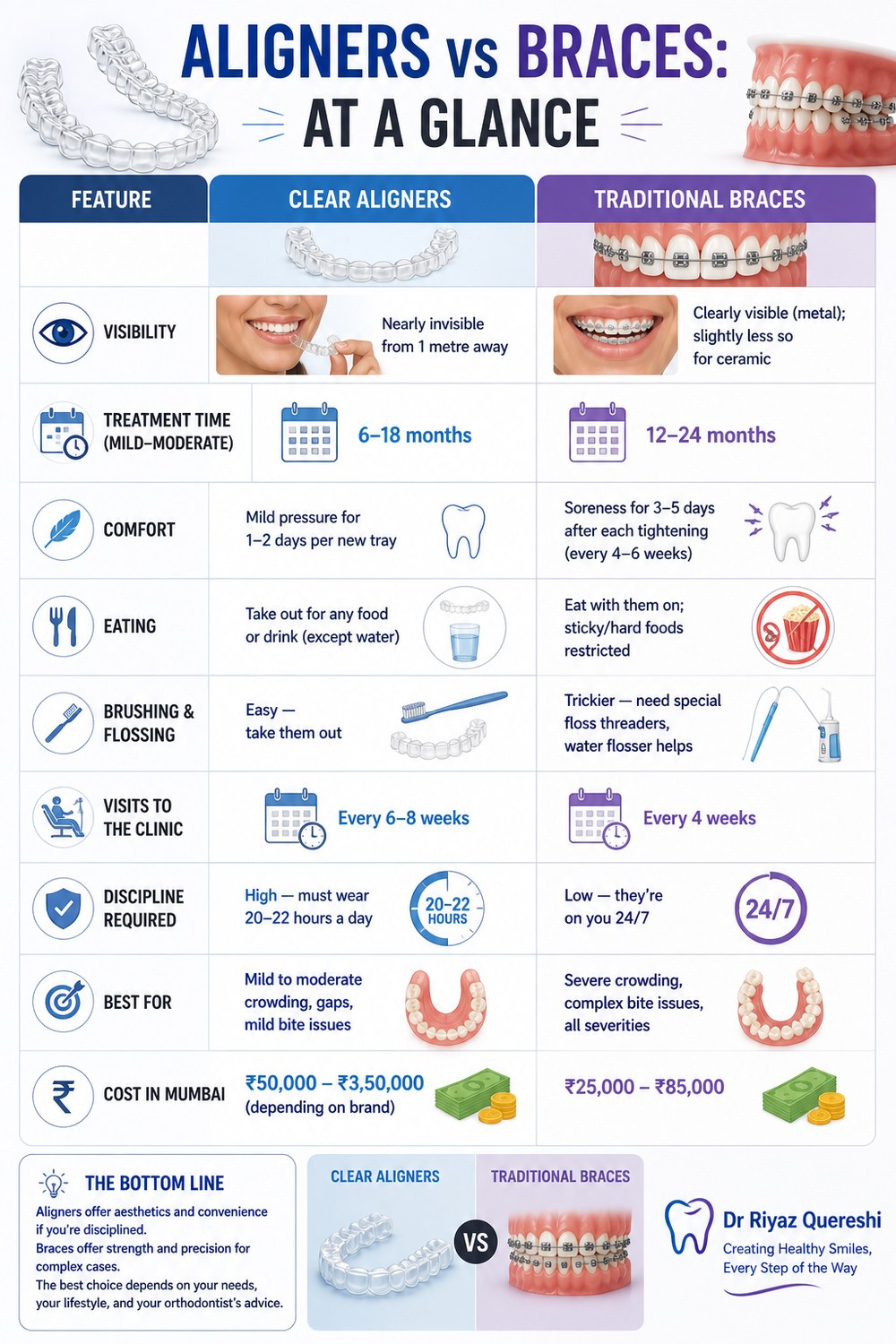
Aligners vs Braces: At a Glance
| Feature | Clear Aligners | Traditional Braces |
|---|---|---|
| Visibility | Nearly invisible from 1 metre away | Clearly visible (metal); slightly less so for ceramic |
| Treatment time (mild–moderate) | 6–18 months | 12–24 months |
| Comfort | Mild pressure for 1–2 days per new tray | Soreness for 3–5 days after each tightening (every 4–6 weeks) |
| Eating | Take out for any food or drink (except water) | Eat with them on; sticky/hard foods restricted |
| Brushing & flossing | Easy — take them out | Trickier — need special floss threaders, water flosser helps |
| Visits to the clinic | Every 6–8 weeks | Every 4 weeks |
| Discipline required | High — must wear 20–22 hours a day | Low — they're on you 24/7 |
| Best for | Mild to moderate crowding, gaps, mild bite issues | Severe crowding, complex bite issues, all severities |
| Cost in Mumbai | ₹50,000 – ₹3,50,000 (depending on brand) | ₹25,000 – ₹85,000 |
Clear Aligners — The Discreet, Adult-Friendly Choice
Clear aligners use a series of computer-designed plastic trays. We start with a 3D scan of your teeth, design every step of the movement in software, and then 15–40 trays are 3D-printed to walk your teeth from where they are now to where you want them. You wear each tray for 1–2 weeks, then move to the next one yourself at home.
Why adult patients choose aligners:
- They're nearly invisible. Colleagues in meetings, clients on calls, and people in your wedding photos won't notice them.
- Removable for eating and special occasions. Drinking chai? Take them out. Cousin's sangeet that evening? Take them out for a few hours, put them back when you're home.
- Easier oral hygiene. Brushing and flossing are normal — no fiddling around brackets and wires.
- Fewer clinic visits. A 6–8 week check-in (vs the 4-weekly tightening with braces) is friendlier to a Mumbai work calendar.
- Predictable timeline. We can show you the exact final position of your teeth on day one, in 3D software, before you even start.
- More comfortable. Mild pressure for 1–2 days when you switch trays, then nothing.
The honest tradeoffs:
- You must wear them 20–22 hours a day, every day. Take them off for chai breaks five times a day and your treatment will stall. Discipline matters.
- Higher cost for branded systems (Invisalign).
- Not for every case. Severe crowding, large rotations and complex bite corrections still need traditional braces or a hybrid approach.
- Slight lisp for the first few days with each new tray — usually gone within a week.
Traditional Braces — Reliable, Powerful, Affordable
Don't write off traditional braces. For complex cases, they're not just an alternative to aligners — they're often the only thing that works. Modern braces have evolved too: smaller brackets, lighter wires, less soreness than the braces of the 1990s.
Three types worth knowing:
- Metal braces — silver brackets, most affordable, fastest results, most powerful for tough cases. The classic "train track" look.
- Ceramic braces — tooth-coloured brackets that blend with your teeth. Less visible but cost more and can stain with chai/coffee/turmeric if hygiene slips.
- Lingual braces — fitted to the inside of your teeth, completely invisible from the front. Most expensive option; takes longer to get used to speaking.
Why patients still choose braces:
- Lower cost — usually a fraction of branded clear aligners.
- No discipline required — they're on, they work, you can't take them off and forget.
- They work on every case — including severe crowding, large gaps, complex bite issues that aligners simply cannot handle.
- Faster movement of difficult teeth — for some movements (especially rotating round teeth), wires apply force that plastic trays can't match.
The honest tradeoffs:
- Visible, especially metal braces.
- Soreness for 3–5 days after each monthly tightening.
- Food restrictions — no sticky sweets (like soft jalebi or chikki), no hard foods that can break a bracket (raw carrots whole, ice, kebab on the bone).
- Tougher hygiene — food gets stuck around brackets; you'll need a water flosser.
- More monthly visits to the orthodontist.
When Braces Still Beat Aligners (Honest Take)
Most cosmetic content tells you aligners are always better. The honest version: aligners are excellent for many adults, but braces are still the right answer for some. Situations where we'll usually recommend braces:
- Severe crowding — when teeth are dramatically overlapping or rotated
- Significant bite issues — deep overbite, severe underbite, large open bite
- Multiple impacted teeth that need to be brought into alignment
- Vertical movements — moving a high tooth down or a low one up. Wires do this much better than trays.
- Patients who know they won't wear aligners 22 hours a day — better to choose something that works regardless of discipline
A good orthodontist will tell you straight if your case isn't suited to aligners — before taking your money. That honesty is the single most important thing to look for in any orthodontic consultation.
"I Have a Wedding / Big Event in 3 Months"
This is the most common adult orthodontic question in Mumbai. Honest answers:
- 3 months — too short for a full result with either option. But it is enough time to make noticeable improvements with aligners (small gaps closed, mild crowding visibly improved). Photos will look better; your teeth won't be perfect.
- 6 months — comfortable timeline for a meaningful aligner result for mild cases.
- 12 months — most mild-to-moderate cases finish completely.
- 18–24 months — moderate-to-severe cases.
If you have an event in 8–12 weeks and want a quick smile upgrade, a smile makeover with composite or porcelain veneers may actually be the right answer instead — orthodontics simply isn't built for the timeline. We'll be straight with you at the consultation.
Lifestyle: How Each Option Fits Your Mumbai Day
A practical comparison most blogs skip:
| Daily activity | Aligners | Braces |
|---|---|---|
| Morning chai | Take aligners out, brush after | Drink as normal — but brush properly |
| Work meetings / video calls | Invisible | Visible (less so for ceramic / lingual) |
| Lunch at the canteen | Take out, eat anything, brush before putting back | Avoid sticky/hard foods, food gets stuck |
| Dating, dinner dates | Discreet — most dates won't notice | Visible at first impression |
| Sangeet / wedding | Take out for the event, put back the same night | They're on; smile photos show them |
| Eating with hands (chaat, biryani) | No problem | No problem |
| Drinking from a straw | Aligners stay in fine | No issue |
| Gym / contact sports | Mouthguard not needed; aligners protect | Mouthguard recommended |
Cost in Mumbai: A Realistic Breakdown
Honest ranges across Mumbai clinics (Jogeshwari, Andheri, Bandra, Goregaon, South Bombay):
Traditional braces:
- Metal braces: ₹25,000 – ₹60,000 for the full treatment
- Ceramic braces: ₹40,000 – ₹85,000
- Lingual braces (inside the teeth, invisible): ₹1,50,000 – ₹3,00,000+
Clear aligners:
- Indian-brand aligners (e.g. K-Line, ClearPath, illusionAligners): ₹50,000 – ₹1,50,000
- Premium imported brands (e.g. Invisalign): ₹1,50,000 – ₹3,50,000, depending on case complexity (number of trays needed)
The cost includes initial scans, all trays/wires, monthly check-ups, and the retainer at the end (worn at night to keep teeth from drifting back). Get any quote in writing before you start.
How to Choose the Right Orthodontist in Mumbai
Orthodontics is a 12–24 month commitment. The orthodontist matters more than the brand of aligner. A practical checklist:
- Ask if they're a qualified orthodontist (BDS + MDS in Orthodontics) — not just a general dentist offering aligners as an add-on. Adult cases especially benefit from a specialist.
- Ask to see real before-and-afters of their own adult cases — not stock photos, not someone else's work.
- Ask for the digital treatment plan before you commit — both aligners and modern braces use 3D scanning to plan tooth movement. You should see your final smile in software before paying.
- Ask what happens if a tray cracks or a bracket falls off — emergency policy, replacement cost, response time.
- Ask about the retainer plan — wearing a retainer at night for life is part of every orthodontic case. Make sure it's included.
- Walk away from anyone selling aligners by post without an in-person exam. Online "mail-order" aligners have a poor track record for adult cases and can damage healthy teeth.
Frequently Asked Questions
Am I too old for braces or aligners?
No. We've successfully treated adult patients in their 50s and even 60s. As long as your gums and bone are healthy, your teeth can be moved at any age. The teeth move slightly slower in adults than in teenagers, but the results are just as predictable.
Will my colleagues notice my aligners?
Almost never from a normal conversation distance. Aligners are designed to be unobtrusive — most patients tell us colleagues only notice if they specifically pointed them out. Photos and Zoom calls usually don't pick them up.
Do clear aligners hurt?
Mild pressure for 1–2 days every time you switch to a new tray is normal — many patients describe it as "snug" rather than painful. Compare this to traditional braces which involve 3–5 days of soreness after every monthly tightening. Both options are very manageable.
Can I switch from braces to aligners halfway through?
Sometimes — especially if your case is responding faster than expected. We can also start with braces for the heavy work and finish with aligners for the polish (called "hybrid orthodontics"). This is increasingly common for busy adults who want to minimise the visible-braces phase.
Will my teeth stay straight forever after treatment?
Only if you wear your retainer. Teeth naturally try to drift back to their original position over time — this is true for every type of treatment. Most orthodontists today recommend wearing a clear retainer at night, indefinitely, after treatment finishes. It's a small habit that protects a major investment.
Do you accept patients from Andheri, Bandra, Goregaon and the western suburbs?
Yes. Tru Smile is on Sahakar Road in Jogeshwari West, with Dr Namrata Nahata leading our orthodontics department. We treat adult patients from across Andheri, Bandra, Goregaon, Oshiwara, Vile Parle and the western suburbs. Most adult patients schedule their check-ups for Saturdays. See our contact page for directions.
So — Aligners or Braces?
A simple decision framework:
- Choose clear aligners if your case is mild to moderate, you have the discipline to wear them 20–22 hours a day, you want minimal visibility for work or social reasons, and you can afford the higher upfront cost.
- Choose ceramic braces if you want the best of both worlds — affordable like metal braces, less visible than metal, and they handle complex cases that aligners can't.
- Choose metal braces if cost is the top priority, your case is severe, or you want the fastest, most powerful tooth movement.
- Choose lingual braces if total invisibility is non-negotiable and budget isn't a concern.
The most important step is the consultation — a proper exam, 3D scan, and digital treatment plan will tell you exactly which option suits your teeth. We'll be straight with you, even if the answer surprises you.
Ready to start your smile transformation?
- Call or WhatsApp: +91 98679 33139
- Book your orthodontic consultation online: trusmiledentist.in/book/ — pick your slot in under a minute
- Visit: Shop No 11, Ruby Tower, Off S V Road, Sahakar Road, Jogeshwari West, Mumbai 400102
- Hours: Mon–Sat 10 AM – 1:30 PM and 5 PM – 9 PM · Sunday by appointment
- Meet our orthodontist: Dr Namrata Nahata and the Tru Smile team
- See our orthodontic services: Tru Smile services
19+ years in practice · 10,000+ happy patients · advanced sterilisation protocols.